

Sand circulation must control both material condition and casting quality
Foundry sand is neither a consumable that must all be discarded after one pour nor ordinary sand that can be reused indefinitely after screening. It repeatedly undergoes mixing, molding, heating, shakeout, separation and further treatment. Grain surfaces and the particle-size distribution change along the way.
A well-managed sand system must answer two questions: can this batch consistently produce acceptable castings now, and will it remain within controlled limits after the next cycle?
Used-sand circulation therefore cannot be judged by recovery rate alone. Base sand, binders, alloy, casting geometry, reclamation equipment and quality control belong in the same assessment. Saving new sand may not pay if it increases scrap and cleaning costs.
Foundry sand requirements involve competing demands
Molds and cores must retain their shape during handling, assembly and exposure to liquid metal, yet be removable afterwards. Sand must form a suitable mold surface and work with the binder, venting and thermal behavior.
Factors to assess together include particle-size distribution, grain shape, flow and compaction, heat resistance, strength, permeability, and subsequent breakdown and cleaning. Improving one measure does not automatically improve overall quality.
For a finer surface, choosing finer sand is only part of the decision: binder demand, venting, and spreading or molding behavior also need evaluation. Handling strength must likewise be considered alongside post-pour residue and cleaning difficulty.
The American Foundry Society’s introduction to foundry sand emphasizes the relationship between physical and chemical sand quality control and casting quality. The sand system should therefore be included in product traceability records.
A practical approach is to define material-use limits for different product families. Heavy sections, slender cores and ordinary external molds may need different sand combinations. Before mixing them, establish whether they will ultimately enter the same return-sand system.
Base sand and binder are separate choices
Silica, chromite, zircon and manufactured ceramic sands are familiar foundry aggregate categories. Their names do not establish a simple ranking from low to high quality. Cost, thermal behavior, density, supply reliability and compatibility with the existing system must be assessed for the actual part.
This article addresses circulation after materials enter the plant, rather than assigning a sand to every alloy. For an initial aggregate comparison, see material choices for printed sand molds. A shop using several aggregates should first define separate collection, allowable mixing and the tests needed after mixing. Correct purchasing cannot compensate for losing material identity during recovery.
Binders turn individual grains into a usable body. Green sand systems involving clay and water have different mixing, hardening and retreatment requirements from chemically bonded systems such as furan, phenolic and sodium silicate. They cannot share one universal used-sand acceptance standard.
Green sand does not simply mean sand with water added arbitrarily. It is a controlled material system with specific requirements for moisture, clay and process conditions. Production should follow validated recipes rather than adjust quantities based on the name.
For 3D printing, also check stable sand spreading, compatibility with the binder or activator, hardening conditions and post-print handling. Material suitable for conventional mixing equipment is not necessarily suitable for a particular printer.
Recovery, reuse and reclamation mean different things
“Sand has been recovered” only confirms collection, not restored production performance. Using three separate terms in plant documentation helps purchasing, production and environmental teams work with the same definitions:
- Recovery: collecting sand from shakeout, cleaning, or removal of loose sand after printing.
- Reuse: returning sand to a specified production stage after prescribed treatment and confirmation.
- Reclamation: removing or reducing detrimental residues through appropriate treatment to restore acceptable conditions for use.
Also distinguish internal circulation from external beneficial use. Sand no longer suitable for foundry production is not automatically suitable for construction, roads or soil; those uses require a separate material and compliance assessment.
Inconsistent accounting causes particular confusion. Calling all collected sand reclaimed sand overstates performance. Counting everything fed into a reclamation unit as reusable also obscures the destinations of fines, contaminants and rejected material.
Process diagrams should identify inputs, outputs and temporary storage at each node. Dust-collector material, metal debris and rejected sand need separate records rather than disappearing into one recycling figure.

What do mechanical and thermal reclamation each address?
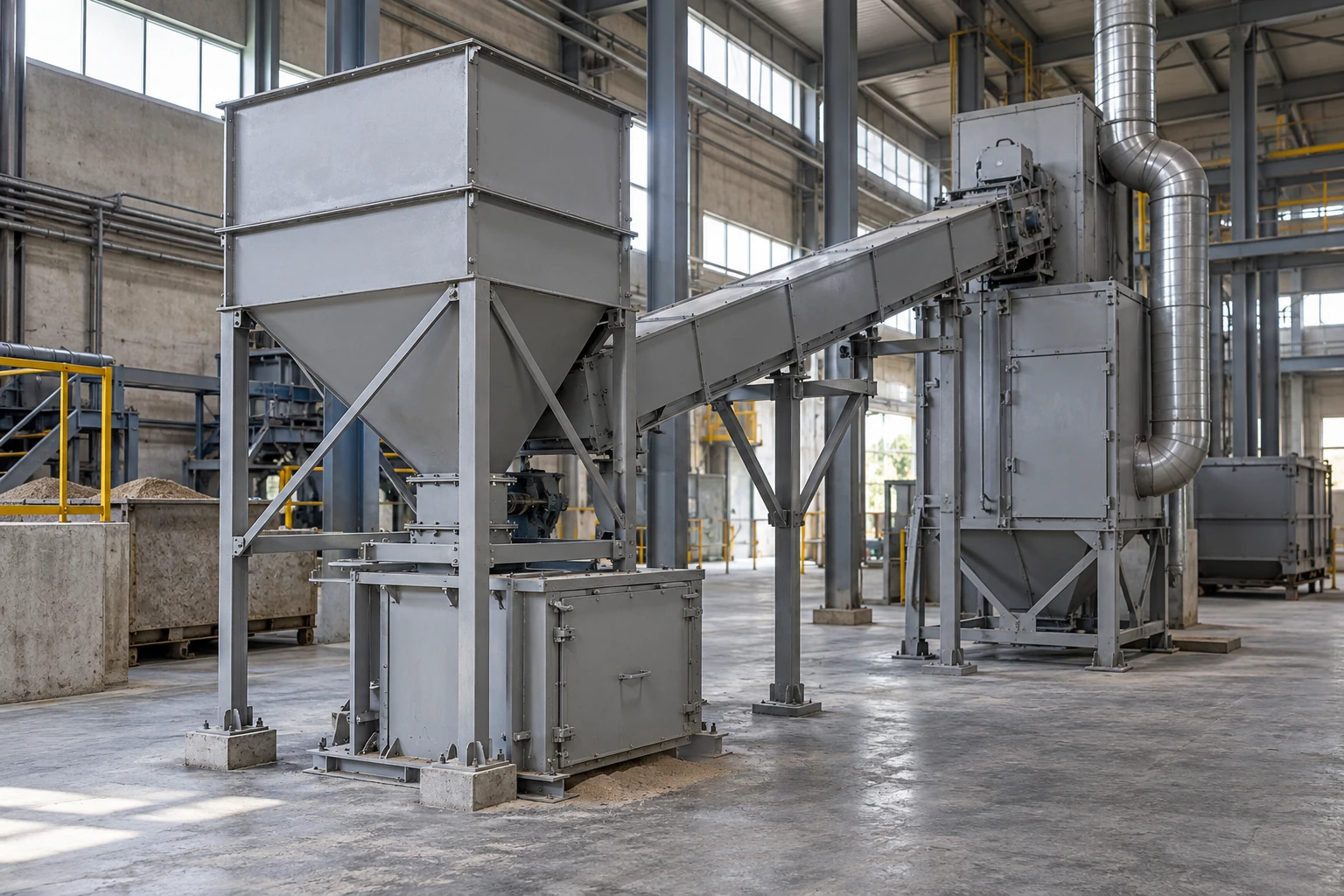
Mechanical reclamation uses suitable friction, attrition or other mechanical action to break down lumps and reduce surface residues, alongside screening, separation and dust extraction. Thermal reclamation uses controlled heat to remove residual binders suitable for that process, with crushing, separation and cooling before or after treatment.
Omega Sinto’s account of the reclamation process shows that reclamation is a sequence involving pretreatment and heat management, rather than an isolated heating step. Its equipment conditions describe a particular solution, not a universal temperature recipe for every sand system.
Thermal treatment does not remove every residue, and one solution does not suit every binder system. Equipment and material suppliers should jointly assess the residues present, intended use after reclamation and emission-control requirements.
More intense mechanical treatment is not always better. Even if residues decrease, changes in grain size and increased fines can destabilize subsequent performance. Decisions should rest on usable reclaimed-sand quality and actual casting results, rather than treatment intensity alone.
Before selecting equipment, ask suppliers to test representative used sand from the plant. Another foundry’s savings case cannot establish that its binders, return-sand composition and production variability match yours.
Testing must establish suitable uses
A lighter color or looser feel does not establish that reclaimed sand can return to any process. Tests should match the binder system and intended use and form workable acceptance criteria.
| Check | What it helps establish | What it does not establish on its own |
|---|---|---|
| Grain size and fines | Particle composition and changes during circulation | A normal average value means the distribution is unchanged |
| Moisture and temperature | Stability of storage, mixing and hardening conditions | One value is suitable for all systems |
| Loss on ignition and related measures | Changes in combustible residue under specified test conditions | One number represents every contaminant |
| Acid demand, pH and related tests | Condition relevant to the particular chemical system | pH replaces all binder-compatibility testing |
| Standard specimens and production trials | Strength, work time and actual operating performance | A single successful trial removes the need to track long-term trends |
These are not one mandatory test package for every foundry. For example, Simpson’s reclamation test program selects grain-size, loss-on-ignition, acid-demand and clay-related tests according to the application and compares conditions before and after treatment. Establishing a baseline before comparison is the useful lesson, rather than copying another plant’s limits.
Sampling locations and methods should also be fixed. A handful from the pile surface may not represent the batch. Combining different times and sources can conceal the origin of an abnormal result.
Link test results to sand batches, reuse proportions, binder batches and casting batches. This helps the team distinguish incoming-material changes from reclamation changes or altered mixing and production conditions.
There is no universal new-sand addition ratio
New-sand additions must be assessed against losses, residue accumulation and grain-size changes. Fixing a ratio without reviewing it over time does not prove system stability.
First define permitted products and process stages, then use limited trials to validate combinations. Observe sand properties, coremaking or molding, casting defects and cleaning. Record ratio changes and avoid introducing several uncontrolled recipe changes at once.
An actionable control plan separates the normal operating range, warning conditions and conditions that stop reuse. If a measure moves away from its baseline, isolate and retest the material before adjusting the recipe, rather than immediately adding binder to restore strength.
More binder can mask a symptom without resolving its cause. Even when strength returns, check gas evolution, cleaning and the next circulation cycle. Manage additions through validated processes rather than infer them from one measurement.
Batch labels should travel with containers and identify at least source, date, material system and treatment status. Identical unlabeled bins for rejected and untested sand allow one handling error to defeat the testing system. Equipment shutdowns or sand changes also need clear temporary-storage and restart checks so abnormal accumulated material is not fed directly into normal returns.
In multi-shift production, check that sampling, weighing and recording are consistent between day and night shifts. A good trial recipe does not define a consistent sand system if daily execution drifts.
3D printing requires at least three separate sand streams
Sand around a printer may look similar, but it has undergone different processes:
- Unbonded sand may already contain an activator or have experienced relevant environmental conditions. Handle it according to the material system.
- Failed, damaged or rejected printed sand parts contain a hardened binder system and cannot be treated as unprinted base sand.
- Used sand removed after casting has experienced heat from the metal and may contain coatings, metal and other residues.
Collect and assess these streams separately; one printing-sand recovery rate cannot replace that management. Hüttenes-Albertus’s additive-manufacturing material information also distinguishes binder systems and conditions for reusing unprinted material. Ratios cannot be transferred unchanged between systems.
For example, current public information for the Cprint 3D SJ-1200 describes a furan-resin and curing-agent system. Its circulation scheme still needs evaluation against confirmed materials, site collection arrangements and test results. An inorganic-binder case from another brand cannot substantiate the same reuse rate.
Printing changes how sand-mold geometry is made, but sand still requires quality control. Readers new to the overall process can review the roles of molding, pouring and shakeout in sand casting.

Circulation still produces outgoing streams to manage
A used-sand system produces material no longer suitable for internal reuse. External use requires testing against the sand source, binder, cast metal, contaminants and intended application, with approval under local requirements.
The risk assessment discussed in the US EPA’s information on beneficial uses of spent foundry sands covers specified silica sands from iron, steel and aluminum foundries and particular uses. It does not cover every sand, mixed waste stream or possible application. This US material is not a direct basis for release in other jurisdictions.
Recyclability does not eliminate occupational health risks. Respirable dust containing crystalline silica and relevant residues require controls based on risk assessment. The UK HSE’s sand reclamation dust-control guidance emphasizes enclosure, extraction at source and effective maintenance. Site measures should be determined by qualified personnel under local requirements.
Acceptance of a circulation project should examine dust collection, storage and transport, maintenance work and residue destinations as well as the return-sand outlet. Collecting pollutants together is a management step, not their disappearance from the records.
Measure improvements against acceptable castings
Normalize new-sand use, binder use, reclamation energy and outgoing material against the same number or weight of acceptable castings. Record product mix, alloy and output so different production tasks are not compared directly.
Also track rework, scrap and cleaning hours attributable to sand-related problems. Reporting lower new-sand purchasing alone gives an incomplete picture if the yield of acceptable castings also falls.
Establishing a baseline for a stable product and extending validation gradually is easier to interpret than pursuing the highest plant-wide reuse ratio immediately. To investigate quality changes, connect sand testing with the mechanisms behind casting defects rather than blaming used sand solely from a defect’s appearance.
Sustainable sand circulation means identifiable materials, controlled performance, traceable outgoing streams and consistent production of conforming castings.
For the economic assessment, see sand reclamation costs and payback.
Frequently asked questions
How many times can foundry sand be reused?
There is no universal count. Systems usually contain sand with different circulation histories. Judge material condition, test results and production performance rather than assign the same lifetime to every grain.
Is thermal reclamation always better than mechanical reclamation?
No. The choice depends on binder and aggregate, required quality, throughput, energy use and emissions. A combination of process stages may be needed.
Does reclaimed sand eliminate silica-dust risk?
No. Reclamation does not automatically remove crystalline silica or dust exposure during work. Controls still depend on a site risk assessment.
Is less binder always better for the environment?
Addition rate alone is insufficient. Inadequate strength and stability can increase rework, scrap or cleaning and worsen the overall impact. Optimize within validated operating conditions.
Can all unbonded printing sand go straight back into the machine?
Do not assume so. Activator content, storage time, temperature and humidity, contamination and equipment material requirements all affect reuse. Follow a confirmed treatment procedure.