
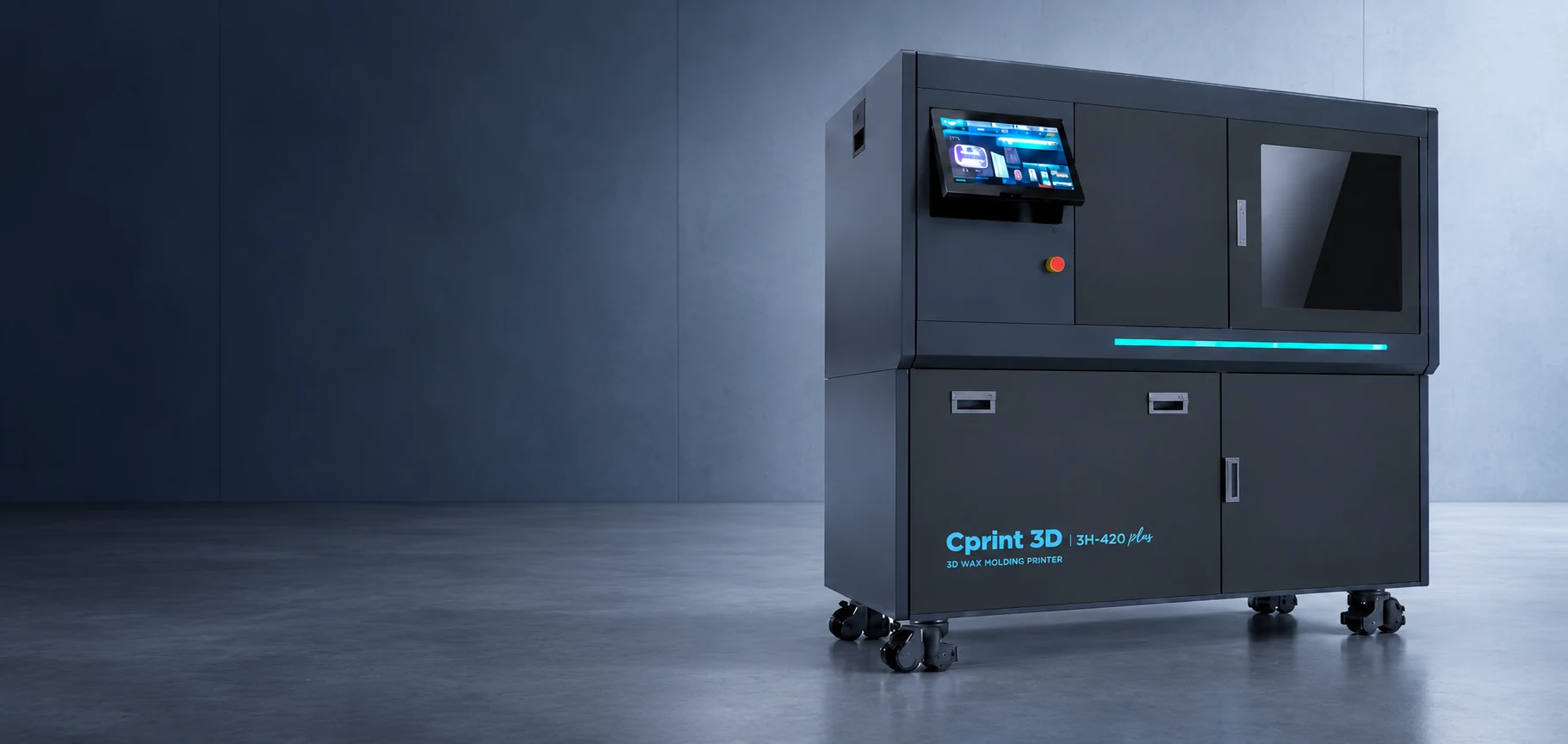
3H-420 Plus 3D Wax Printer for Jewelry and Investment Casting
The 3H-420 Plus is a 3D wax printer designed to produce high-precision, 100% wax patterns for jewelry and precision investment casting. Its 410 × 206 × 150 mm build area and vertical build rate of up to 6 mm/h support custom designs, short runs, and batch production.
WAX PATTERN PRODUCTION
Common Challenges in Wax Pattern Production
Jewelry and investment casting manufacturers must balance customization, fine detail, changing order volumes, and consistent wax pattern quality. Conventional pattern-making workflows can make that balance difficult when designs change frequently or production requirements vary.
Tooling Lead Times
Conventional wax pattern production may require a master pattern and dedicated tooling before repeat parts can be produced, adding steps before casting begins.
Changing Order Volumes
Custom pieces, short runs, and repeat batches require different production plans, making fixed tooling workflows less flexible when demand changes.
Fine-Detail Demands
Filigree, openwork, sharp edges, and complex internal features must remain intact through pattern production, cleaning, handling, and assembly.
Batch Consistency
Multiple patterns produced together must maintain controlled dimensions and surface quality across the build platform.
THE DIGITAL ROUTE
A Direct Digital Route to Wax Pattern Production
Moving approved CAD data directly into wax pattern production creates a more flexible route through these challenges. The 3H-420 Plus combines a 410 × 206 × 150 mm build area, three Xaar printheads, and a vertical build rate of up to 6 mm/h to support custom designs, short runs, and batch production.


DETAIL AND SURFACE
Fine Details and Smooth Surfaces for Casting
Fine features and surface consistency influence how a wax pattern is inspected, assembled, and prepared for investing. The 3H-420 Plus is designed to reproduce intricate geometry with adjustable 15 µm layers, stable motion, and removable wax support.
Using Cprint 3D build wax, qualified filigree structures as fine as 0.12 mm can be produced under controlled printing conditions. These capabilities help preserve filigree, openwork, sharp edges, and complex contours while limiting visible layer marks on the wax pattern surface. Dimensional accuracy and surface roughness values are listed separately in the technical specifications.

- 0.12 mmFine Filigree
- Produce qualified fine filigree and openwork structures down to 0.12 mm under controlled printing conditions.
- 15 µmAdjustable Layers
- Use fine layer control to reproduce small features and complex contours in wax.
- Ra 0.2–1.6Specified Roughness
- Provide a clearly defined wax pattern surface roughness range for technical evaluation under the specified test conditions.
PRODUCTION SYSTEM
Stable Production and Efficient Wax Use
Production equipment must deliver more than a strong first sample. The 3H-420 Plus combines a linear-motion architecture with circulation-heated Xaar printheads to help maintain controlled movement and stable wax flow during longer production builds.
Continuous wax circulation helps keep the material within the required processing condition, while the linear-motion system is designed to limit vibration at higher operating speeds. Together, these systems support dimensional consistency and repeatable wax pattern surfaces across a full build platform.
The material delivery and recovery system is designed to improve wax utilization and reduce unnecessary material waste during batch production. Actual consumption depends on part geometry, layout density, support requirements, operating conditions, and maintenance.
Circulation-Heated Printheads
Maintain controlled wax flow during continuous production and help reduce interruptions associated with unstable material flow.
Linear-Motion Control
Support smooth, controlled movement with reduced vibration during higher-speed operation.
Efficient Wax Use
Improve build and support wax utilization through controlled printing, build layout, material delivery, and recovery.
Internal test data. Actual output, material consumption, and operating performance vary with geometry, build layout, environment, and maintenance conditions.
MATERIAL SYSTEM
100% Wax Patterns for Lost-Wax Casting
Unlike castable resin systems, the 3H-420 Plus prints with a proprietary, paraffin-based build material composed entirely of wax. The red build wax is paired with a white wax-based support material, allowing delicate features and complex internal geometry to remain supported during printing and to be cleaned after the build.
The build wax combines controlled hardness with flexibility to help reduce brittleness during handling. With 0.008% measured ash content, low shrinkage, and a melting range of 60–63°C, it is designed to integrate with established lost-wax casting processes when the specified material handling and foundry cycle are followed.
After printing, the support wax is removed using the recommended Cprint 3D cleaning procedure. Under qualified conditions, cleaning can typically be completed in approximately 15–20 minutes. The wax pattern is then dried and inspected before assembly or the next stage of the customer’s casting workflow.

Red Build Wax
The red build wax forms the geometry and visible details of the final wax pattern.

White Support Wax
White wax-based support material holds delicate features and complex geometry during printing.

Cleaned Wax Pattern
After the qualified cleaning process, the wax pattern is dried and inspected before assembly or casting preparation.
- 0.008%
- Measured Ash Content
- 60–63°C
- Build Wax Melting Range
- Approx. 15–20 min
- Cleaning Time Under Qualified Conditions
APPLICATIONS
Wax Patterns for Jewelry and Precision Investment Casting
The 3H-420 Plus supports both fine jewelry production and larger precision casting patterns. Application settings, build orientation, and layout should be evaluated according to the geometry, casting process, and required surface quality of each project.

JEWELRY CASTING
Fine Jewelry Patterns, From Custom Designs to Repeat Batches
Use the 3H-420 Plus as a 3D wax printer for jewelry patterns ranging from individual custom designs to repeat production batches. Fine layer control and removable wax support make it suitable for rings, pendants, earrings, bracelets, filigree, openwork, and other complex forms that are difficult to produce by hand.
The digital workflow moves an approved jewelry design into physical wax pattern production without first creating conventional pattern tooling, supporting customization and flexible batch sizes.
Rings · Pendants · Filigree · Bracelets · Customized jewelry patterns
Explore Jewelry Casting Applications
PRECISION INVESTMENT CASTING
Digital Wax Patterns for Complex Precision Components
For industrial investment casting, the build area can accommodate impellers, housings, mechanical components, and other complex wax patterns. The system can be evaluated for silica-sol shell and gypsum investment workflows used in precision metal casting.
Direct digital wax pattern production can reduce tooling lead time for prototypes, replacement parts, customized components, and low-to-medium production volumes. Final suitability should be verified through sample printing and casting trials using the customer’s actual geometry, alloy, and foundry process.
Impellers · Housings · Mechanical components · Complex industrial casting patterns
Explore Investment Casting ApplicationsDIGITAL WORKFLOW
From CAD File to a Ready-to-Cast Wax Pattern
Follow a controlled digital workflow from file preparation and build layout to wax printing, support removal, and inspection. Casting then continues through the customer’s validated jewelry or investment casting process.
Supported file formats
- STL
- SLC
- JCAD
- MATRIX
Build inspection and layout are prepared with Wukong Slicing & Layout Software.
Prepare the Digital Model
Complete the design in the customer’s preferred CAD or jewelry design software, check the geometry and dimensions, and export a supported STL, SLC, JCAD, or MATRIX file.

Inspect and Arrange the Build
Use Wukong Slicing & Layout Software to inspect the file, define the build orientation, arrange single or multiple patterns, and prepare the print job according to quantity, spacing, and support requirements.

Print Build Wax and Support Wax
The 3H-420 Plus deposits red build wax and white support wax through its three-printhead jetting system to form the wax pattern layer by layer.

Remove Support and Inspect the Pattern
Remove the support wax using the qualified Cprint 3D cleaning procedure, then dry and inspect the pattern for dimensional and surface requirements before assembly or transfer into the customer’s validated casting workflow.

TECHNICAL DATA
3H-420 Plus Technical Specifications
Review the 3H-420 Plus printing system, build capacity, accuracy, materials, software, and installation requirements. Specifications are based on current product documentation and qualified test conditions.
| Product model | Cprint 3D 3H-420 Plus |
|---|---|
| Forming principle | Multi-nozzle wax jetting technology |
| Printheads | 3 Xaar printheads |
| Ejection points | 2,000 per printhead |
| Layer thickness | 15 µm, adjustable |
| Maximum printable build area | 410 × 206 × 150 mm |
|---|---|
| Layout envelope including build wall | Up to 420 mm |
| Vertical build rate | Up to 6 mm/h |
| Nominal resolution | 2900 × 2900 × 1700 dpi |
|---|---|
| Typical dimensional accuracy | ±0.02 mm per 20 mm |
| XYZ positioning accuracy | ±2 µm |
| Specified surface roughness | Ra 0.2–1.6 |
| Qualified minimum filigree feature | 0.12 mm under controlled conditions |
| Build material | Proprietary paraffin-based 100% wax |
|---|---|
| Support material | Wax-based support material |
| Property | Build Wax | Support Wax |
|---|---|---|
| Composition | 100% wax | Wax-based support material |
| Color | Red | White |
| Package weight | 1.5 kg/unit | 1.5 kg/unit |
| Density at 80°C, liquid | 0.80 g/ml | 0.86 g/ml |
| Melting point | 60–63°C | 55°C |
| Softening point | 50–55°C | N/A |
| Volumetric shrinkage, 40°C to room temperature | 1.1% | N/A |
| Linear shrinkage, 40°C to room temperature | 0.7% | N/A |
| Penetration at 25°C, 1/10 mm | 9 | N/A |
| Ash content, ASTM D5630-13A | 0.008% | N/A |
| Flash point | 230°C | 230°C |
| Slicing and layout software | Wukong Slicing & Layout Software |
|---|---|
| Supported file formats | STL, SLC, JCAD, MATRIX |
| Print controller operating system | Ubuntu 22.04 |
| Layout workstation requirement | Windows 10 or later |
| Recommended operating temperature | 18–28°C |
| Power supply | AC 220–240 V |
| Machine dimensions | 1470 × 680 × 1380 mm |
| Machine weight | 450 kg |
Specifications are based on current product documentation and qualified test conditions. Actual performance can vary with geometry, build layout, material batch, operating environment, maintenance, and casting process. Specifications are subject to confirmation and change without notice.
HAVE A QUESTION?
Frequently Asked Questions About the 3H-420 Plus 3D Wax Printer
Find practical answers about the 3H-420 Plus build capacity, detail, printing speed, wax materials, support removal, software, installation, and pricing.
The maximum printable build area is 410 × 206 × 150 mm. A single larger pattern or multiple smaller patterns can be arranged within this space. The usable capacity of each build depends on part geometry, orientation, spacing, support requirements, and the build wall defined in the layout software.
The system uses an adjustable 15 µm layer thickness and is specified to produce qualified filigree structures as fine as 0.12 mm under controlled conditions. Typical dimensional accuracy is ±0.02 mm per 20 mm, while actual results depend on geometry, orientation, material condition, machine calibration, and measurement method.
The specified vertical build rate is up to 6 mm/h. Total job time is determined by part height, layout density, geometry, selected parameters, and support requirements. Cprint 3D can estimate build time more accurately after reviewing the customer’s production file.
The 3H-420 Plus prints with a proprietary, paraffin-based 100% wax build material and a wax-based support material. It does not use castable photopolymer resin. This gives manufacturers wax patterns that can be evaluated within their established lost-wax casting process.
The 3H-420 Plus deposits red build wax together with white wax-based support material. After printing, the support wax is removed using the qualified Cprint 3D cleaning procedure. The pattern is then dried and inspected before pattern assembly or the next stage of production.
Print jobs are prepared with Wukong Slicing & Layout Software. Supported file formats include STL, SLC, JCAD, and MATRIX. The print controller runs on Ubuntu 22.04, while the layout workstation requires Windows 10 or a later version.
The machine requires an AC 220–240 V power supply and a recommended operating temperature of 18–28°C. The equipment measures 1470 × 680 × 1380 mm and weighs 450 kg. Final site planning should also cover access clearance, floor loading, ventilation, material storage, and the required post-processing area.
Pricing depends on the destination market, system configuration, material package, installation, training, and service requirements. Contact Cprint 3D with your country, application, and production requirements to receive a formal quotation and the appropriate delivery configuration.
START WITH YOUR PART
Send Your CAD File for a Sample Print
Not sure whether the 3H-420 Plus is suitable for your wax pattern, casting process, or production volume? Send our team your 3D model, drawing, or project requirements. We will review the geometry, recommend a printing approach, and help you evaluate the wax pattern before equipment selection.
Information That Helps Us Evaluate Your Project
- 3D model or supported production file
- Pattern dimensions
- Jewelry or precision investment casting application
- Casting process and target alloy
- Required quantity or expected production volume
- Delivery country or region