
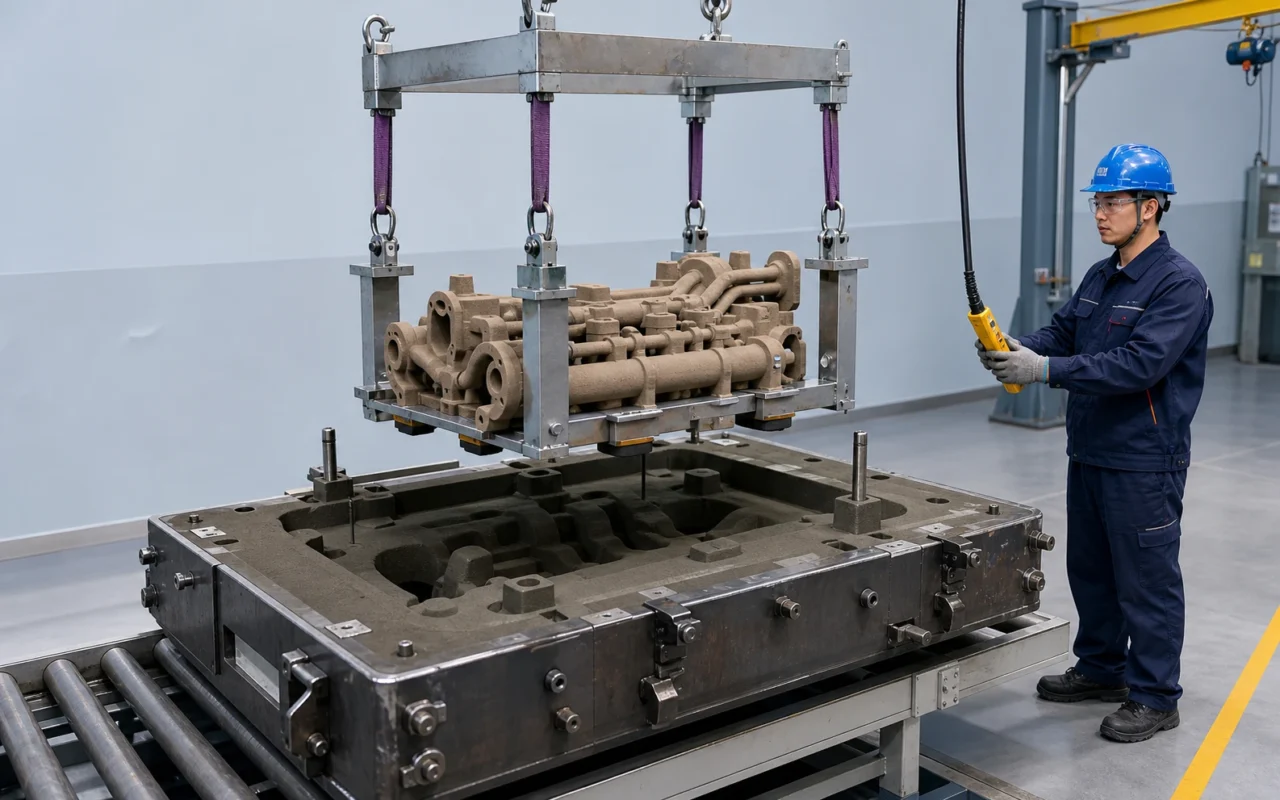
Foundry digitization does not have to begin by replacing an entire conventional line. Many plants already have efficient external patterns; the real constraint is a complex cavity, core-box development or multi-core assembly. Keeping the conventional outer mold and printing only the difficult cores can be a lower-risk, more transparent way to introduce additive manufacturing.
This hybrid model combines an efficient mature process and tool-less digital manufacturing in the same casting. Global 3D-printing market data cited in the source places the 2024 market near USD 21.9 billion and China’s market above RMB 50 billion. Aerospace, medical and automotive applications represented nearly half of downstream use in a 2021 breakdown, with aerospace around 58% of industrial AM use in China. Hybrid adoption lets foundries address high-value, complex and low-volume work without rebuilding every process at once.
Why print only the core?
Automated or semi-automated lines can make a simple external mold quickly at stable volume, existing tooling may be fully amortized, and operators understand its quality controls. Printing that mold may add little value. Internal cores may require several boxes, loose pieces and assembly. Printing the high-complexity elements can:
- avoid or reduce complex core-box investment;
- speed changes to oil, coolant and internal surfaces;
- consolidate cores and reduce gluing and location work;
- retain existing molding, pouring and workforce capability; and
- concentrate limited printer capacity where it creates the most value.
See core consolidation and assembly optimization.
Managing the interface
The conventional mold and printed core come from different processes but must share datums, shrink rules and revision control. Core prints, locating surfaces, clearances, clamping and venting need first-article verification.
- materials and lots used for mold and core;
- coordinate systems, shrink factors and inspection datums;
- core-print dimensions, assembly clearance and permitted dressing;
- coating, drying, storage and maximum wait time;
- assembly direction, lifting tools and error-proof identification; and
- synchronization of both data sets after a design change.
Tool wear with an unchanged core—or a revised core against an old pattern—can produce mismatch. Digital files and physical tooling belong in the same change process.
Suitable production volume
There is no fixed upper quantity. Hybrid molding works well for product families with a repeated exterior and varied internal geometry, or volumes that justify keeping an efficient external tool while a complex core box remains too costly. For very few development castings, printing both mold and core may be faster. At stable high volume, a mature core box or automated coremaking process may have lower unit cost. Compare core-box cost, assembly time, printing, defects and change frequency using the cost and ROI framework.
Material and casting compatibility
The printed core and conventional mold may use different sand and binders. Evaluate gas, strength, thermal expansion, collapsibility and coating compatibility. An excessively strong core can make shakeout difficult, and a gas difference can change porosity risk. First trials should examine fins at the interface, inclusions, gas defects, dimensions and internal cleanliness. Hybrid production remains part of the mold and core process, requiring feedback among design, print and casting teams.
Recommended introduction sequence
- Find current parts with high core-box cost, extensive assembly or frequent changes.
- Keep the mature external mold and redesign the printed core and interface.
- Print a representative section or first set and verify assembly, coating and handling.
- Run a trial and inspect the cavity, dimensions and defects.
- Measure cost and cycle time for the complete route.
- Expand to related parts after the process is stable.
The SJ-1200 can produce complex cores for a hybrid route. Share your external mold, core data and assembly issues for an evaluation, and review the foundry readiness checklist.
Frequently asked questions
What is a hybrid sand-casting process?
It combines manufacturing routes in one casting, such as a conventional external mold and a 3D-printed complex internal core followed by normal assembly and pouring.
Why not print the complete mold?
If the exterior is simple, volume is stable and existing tooling is highly efficient, printing adds little economic value. Printing only the difficult core targets the constraint.
Can a printed core be installed in a conventional mold?
Yes, after validating core prints, location, clearance, materials, coating, venting and assembly strength against common datums and revisions.
Which quantities suit hybrid production?
There is no universal number. It is often attractive for repeated exteriors and complex or changing interiors at low or medium volume.
How are tolerances managed across the interface?
Use one coordinate and shrink system, specify core-print and clearance inspection, and synchronize digital and physical-tool records after every design change.