
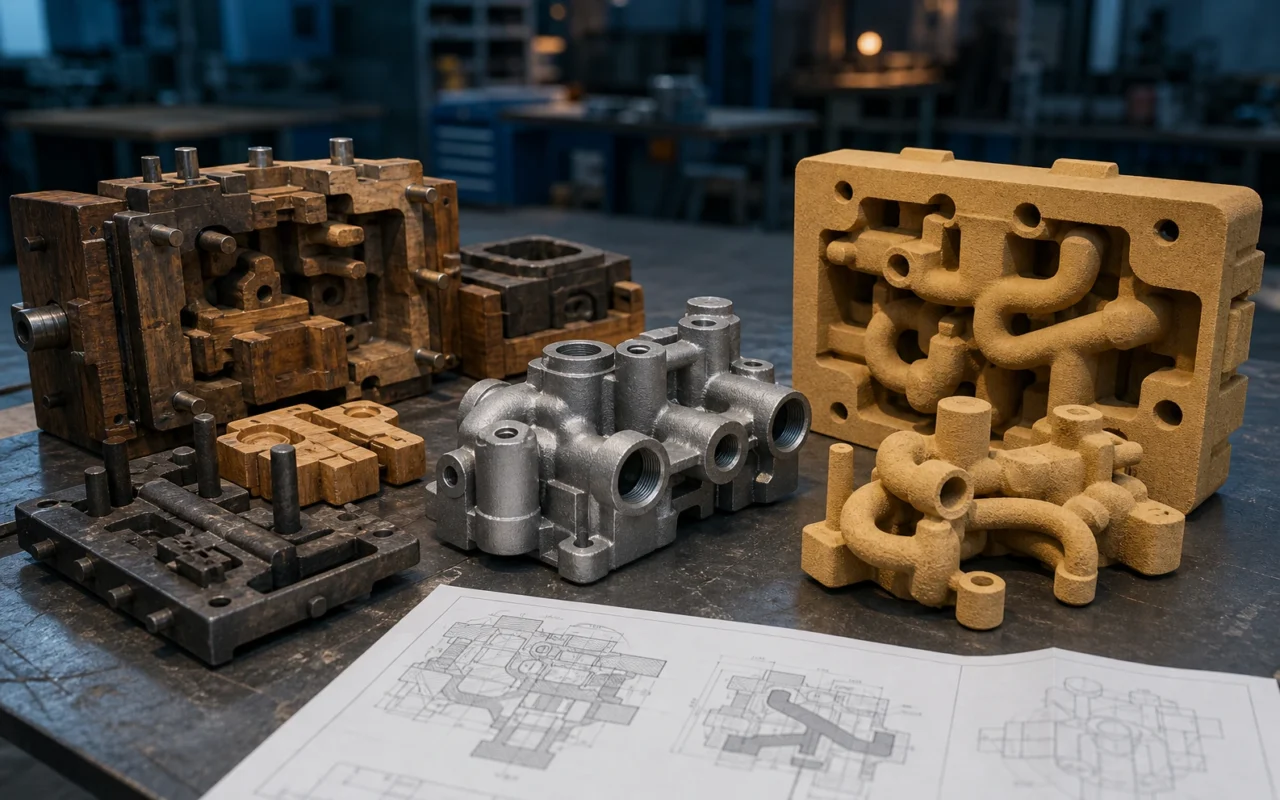
Sand 3D printing is often summarized as “no tooling and faster delivery,” but those advantages only have meaning within a specific order. Printing avoids a dedicated pattern or core box for every geometry, yet introduces machine time, data preparation, sand and binder, depowdering, curing and quality-validation costs. It can substantially reduce up-front investment for complex low-volume work; for simple parts with stable repeat demand, amortized conventional tooling may still be less expensive.
A foundry should therefore compare total cost and elapsed time from order acceptance to an approved casting—not simply ask for the price of a cubic meter of printed sand.
Where the two routes incur cost
A conventional route normally includes patterns, core boxes, fixtures, trials and revisions. Once the tooling is mature, molding can be fast and economical for repeat production. Tooling still consumes time and capital and must be identified, stored, maintained and eventually retired.
A digital route moves more of the front-end work into casting engineering, model splitting, gating, risering, venting, slicing and nesting. The printer then produces only the occupied build volume. Hard-tool development is reduced, but depowdering, curing, coating, mold assembly and casting inspection remain.
| Cost area | Conventional tooling | Sand 3D printing |
|---|---|---|
| Up-front work | Patterns, core boxes, fixtures and trials | Data preparation, process validation and first print |
| Design changes | Tool modification or replacement may be required | Revise the digital file and revalidate |
| Per-part materials | Molding sand, binder and tooling depreciation | Printing sand, binder and machine occupancy |
| Labor | Patternmaking, coremaking, assembly and maintenance | File preparation, depowdering, curing and inspection |
| Hidden cost | Storage, damage and time spent locating tools | Unused build volume, maintenance and failed reprints |
| Quality cost | Assembly variation and tool wear | Parameter drift, handling damage and material variation |
A practical middle ground is described in our guide to hybrid molding with conventional molds and printed cores.
Why lead time can become shorter
Conventional projects may wait for tool design, outsourced machining, assembly and trials. Once the digital process is approved, a printed route can move directly into production and respond quickly to design changes or urgent demand. Different core designs can also share one build box, which improves flexibility for high-mix, low-volume work.
“The print takes a few hours” does not mean “the casting ships in a few hours.” Data repair, process review, scheduling, depowdering, curing, transport, pouring and inspection all belong in a customer-facing lead-time commitment.
Projects most likely to create value
Designs that are still evolving
Digital changes are generally more flexible than repeated hard-tool revisions. Foundry validation can begin earlier, and the team is less likely to postpone an improvement simply to protect an existing tooling investment.
Complex cores and large core assemblies
Core consolidation can reduce tooling, locating points and manual assembly. The combined design must still provide adequate sand-removal paths, venting, handling strength and pouring stability.
One-off, low-volume and spare parts
Small orders cannot spread tooling cost over many castings. Legacy parts may have no usable pattern. Drawings, archived models or reverse-engineered data can sometimes restore the mold digitally, although reconstruction work and part size still affect the economics.
Orders where response time has high value
Line-down spares, trade-show prototypes and critical development milestones may be more sensitive to time than to unit manufacturing cost. Downtime, delay and a missed validation window should be included in the business case.
When conventional tooling is still the better choice
For simple geometry produced in high volume over many years, mature tooling and fast repeat molding may retain a clear cost advantage. A foundry with stable coremaking equipment and skilled operators should not replace a proven route solely to use a newer technology.
Hybrid production is often more sensible: keep the conventional external mold and print only the complex or frequently changing cores. This protects existing capacity while concentrating additive manufacturing where it removes the most tooling and assembly work.
Build an ROI model you can review later
- Select five to ten representative orders from the previous year, not only the parts most favorable to printing.
- Collect actual tooling, coremaking, rework, lead-time and scrap data for each order.
- Estimate printing, finishing, shipping and casting-validation cost against the same quality standard.
- Calculate separate scenarios for the first casting, a small batch, annual demand and likely design changes.
Automotive, heavy-equipment and international sand-printing programs have reported major cost reductions. Treat such figures as reference points, then build the investment model around your own order mix, utilization and quality data. Our six-stage implementation roadmap provides the next step.
Reported project results
Industry examples show several forms of return. For an aerospace turbine-blade mold, DMG MORI reportedly replaced an 18-piece assembly for a complex internal cavity with a single formed component intended to support operating conditions above 1,600°C. An American Foundry Society estimate cited a reduction in mold cost from USD 3,800 per ton to USD 620 per ton. Dongfeng Motor reported a 74% reduction in tooling-material use for a transmission housing.
A Japanese foundry combining sand-mold printing with defect detection reported annual inspection savings of about RMB 23 million. Voxeljet also reported reprinting a sand mold within seven hours of a Tesla Cybertruck design-change request and sending the casting to a machining center the following morning. The examples relate to consolidation, material savings, automated inspection and urgent engineering changes; the return is broader than the price of sand alone.
The SJ-1200 sand 3D printing system can form part of a digital mold-production plan. To evaluate a machine purchase or a print-first trial, submit representative mold data, monthly demand and your current cost structure. You can also review a long-term sand-printer operating case.
Frequently asked questions
Is a 3D-printed sand mold always cheaper than conventional tooling?
No. Printing reduces up-front tooling but adds machine, material and finishing cost per job. Low-volume, complex and frequently changing work is more likely to benefit. Simple high-volume work needs a long-term comparison after tooling is amortized.
At what volume does conventional tooling become more economical?
There is no universal break-even quantity. It depends on tool price, molding rate, sand volume, nesting efficiency, labor and expected revisions. Calculate it for the actual component.
How does sand 3D printing shorten lead time?
It manufactures a mold or core directly from 3D data and reduces pattern and core-box design, machining and trial time. Process review, cleaning, curing, pouring and inspection still remain.
Which costs are most often missed in an ROI calculation?
Common omissions include data repair, maintenance, unused build volume, depowdering labor, handling damage, coating, curing and validation, plus storage and maintenance for conventional tooling.
Is sand 3D printing suitable for urgent spare parts?
It can be, when reliable drawings or recoverable 3D data exist, quantity is limited and time has high value. Material, dimensional and foundry validation cannot be skipped simply because the order is urgent.