
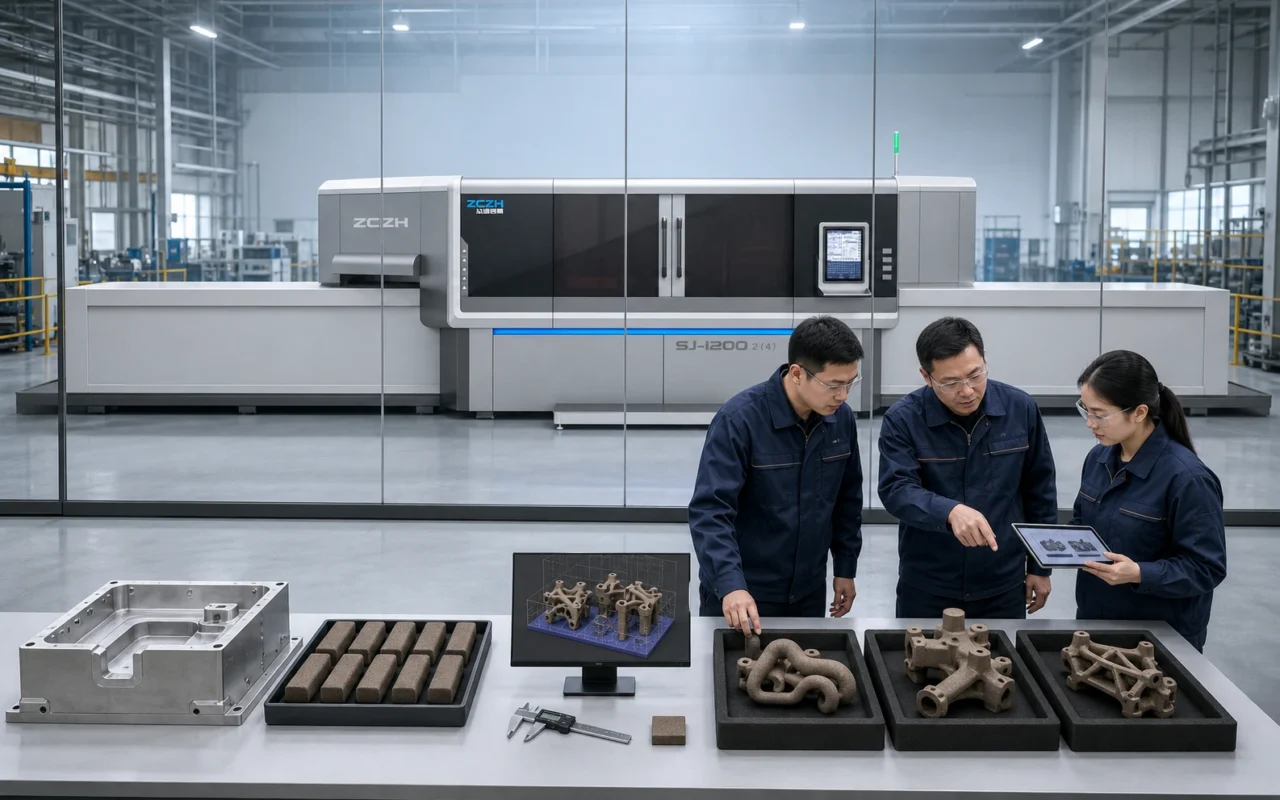
“The industry is going digital” is not a sufficient reason to buy a sand 3D printer. Value depends on a sustained flow of suitable work, engineering capability from data through casting, and a balanced cycle across printing, finishing and pouring.
Begin with your orders, not a longer list of machine specifications. Nearly half of foundries reportedly struggle to recruit qualified coremakers. Printing can reduce dependence on complex manual coremaking and multi-core assembly, and suitable projects have reported development-to-production lead-time reductions above 70%. One German foundry also reported 40% less waste sand and 25% lower energy use after adoption, illustrating how order mix, labor and environmental pressure can converge.
Review the order mix
Screen the previous 12–24 months for work with high pattern or core-box cost at limited quantity, difficult multi-core assembly, repeated design changes, low-volume spares with missing tooling, expensive delivery delays or a growing high-mix/low-volume share. Record mold volume, tooling, coremaking and assembly hours, scrap, lead time and annual demand. A machine investment produces stable return only when suitable work forms a consistent load. Use the cost and ROI guide.
Signals that purchasing is premature
- reliable 3D data or casting-process design is unavailable;
- there is no space for cleaning, curing, coating and inspection;
- qualified sand, binder and service parts cannot be supplied consistently;
- the quality system cannot trace files, settings and material lots;
- labor reduction is the only justification, without new roles and training; or
- there is no defined pilot part and acceptance standard.
If most work is simple and stable at high volume and automated molding and coremaking are well utilized, printing may not address the present bottleneck. Outsourcing a few occasional complex jobs is often the safer route.
Buy a machine or outsource first?
Outsourcing validates demand and process with real orders while capturing print volume, finishing, shipping damage, casting yield and customer acceptance without taking immediate utilization risk. An in-house system becomes more attractive when work is frequent, scheduling and transport constrain delivery, files require stronger confidentiality, or materials and settings need continuous optimization. Compare outsourced price, logistics and waiting with equipment, facility, utilities, staff, maintenance and inventory.
Site-readiness checklist
Data and engineering
Provide mold/core modeling, casting design, file repair, slicing, nesting and revision control. The printer does not optimize every gate, riser and defect automatically.
Materials and environment
Define sands, binders, coatings and reuse strategy plus storage, temperature, humidity, ventilation, dust and waste controls.
Finishing and logistics
Plan build-box movement, removal, depowdering, curing, coating, drying, inspection and transport, especially lifting and support for large fragile cores.
Quality and safety
Trace material lots, job files, machine condition and inspection. Assess dust, chemicals, mechanics, lifting and fire risk.
People and service
Assign process, data, operation, maintenance and quality owners and verify supplier training, remote support, spares, printheads and preventive maintenance.
Continue with production-line planning.
Use a pilot to answer five questions
A pilot should confirm repeatable printing, safe cleaning, successful mold assembly, acceptable castings and acceptable total cost. Include a simple baseline, a normal medium-complexity part and a high-value complex part rather than extrapolating from one showpiece.
After the pilot, use actual build utilization and finishing cycle to evaluate the SJ-1200. See sand molds and cores or request a project review. The next step is the six-stage roadmap.
Frequently asked questions
How can a foundry tell whether it needs a sand 3D printer?
Quantify complex low-volume, high-tooling, frequently changing and urgent work, then determine whether it creates a stable load and whether engineering, finishing and quality capabilities exist.
Which parts belong in the first pilot?
Choose commercially relevant, measurable parts with clear process problems plus one simple baseline. Avoid a visually complex showpiece with no production need.
Is printing ideal for simple high-volume castings?
Usually not the first choice. Mature tooling and automated molding may be more economical. Printing is strongest for complexity, low volume, change and missing tools.
What skills are required?
Teams need 3D data, casting, sand and binder, finishing, traceability and safety knowledge in addition to machine operation.
Should a foundry outsource before buying?
When demand is uncertain, outsourcing real jobs provides lower-risk cost and quality data. Buy when volume, confidentiality, lead time and continuous process-development needs are clear.