
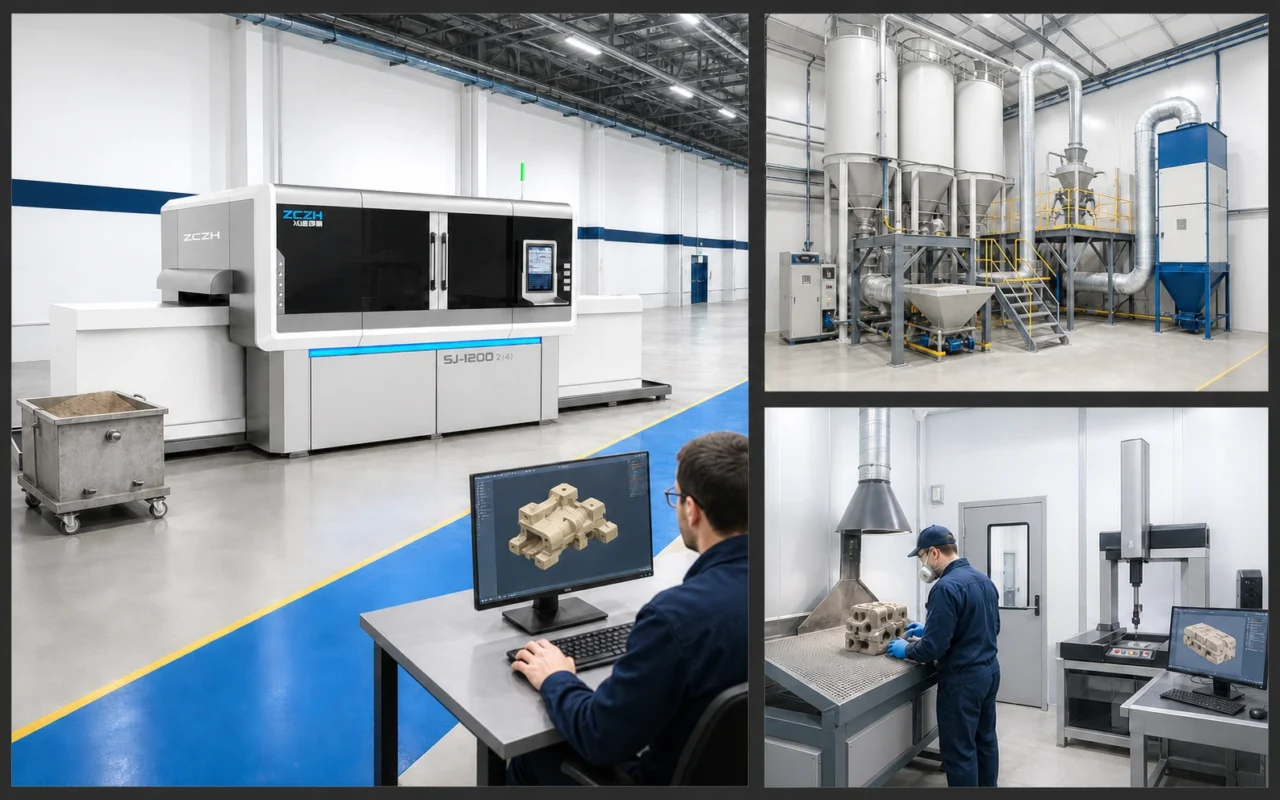
Scaling from one sand 3D printer to a stable production line is not mainly a matter of fitting more machines into a building. Data, sand, binder, work in process and people need to move continuously and remain traceable. A fast printer cannot deliver high effective output when sand supply, depowdering, curing, coating or inspection becomes the bottleneck.
Start with target castings and required output per shift, then work backward to the line configuration.
Define capacity before counting machines
Collect at least three representative task groups: frequent cores, oversized molds and high-mix low-volume orders. For each group, record the bounding size, actual sand volume, parts per build, part weight, cleaning difficulty, finishing time and delivery cadence. Nominal build speed becomes monthly output only after nesting density, box change time and uptime are included.
A basic capacity model should cover:
- representative parts per build box;
- builds completed per shift and box-change time;
- parallel capacity for curing and depowdering;
- maintenance, printhead checks and planned downtime;
- first-article validation, rework and abnormal batches; and
- seasonal changes in order mix and reserve capacity.
Once output is defined, you can decide whether one printer needs several exchange boxes or several printers should share sand supply, recovery and post-processing systems.
Functional areas in a complete line
Data and production preparation
File inspection, casting-process design, slicing, nesting, work orders and version control belong here. The file sent to the floor must match the approved revision, and each job should be traceable to its sand lot, binder lot and critical settings.
New sand, reclaimed sand and binder storage
Materials need clear identification, controlled storage and measures against cross-contamination. Recovered sand must be screened, dedusted, cooled or reclaimed and then used only at an approved ratio. “Recyclable” does not mean unlimited reuse without testing.
Printing and material movement
The print area needs stable temperature and humidity, compressed air, power, network access and maintenance clearance. Routes for build boxes, carts, cranes and forklifts should be separated from walkways to reduce collisions, mold damage and dust transfer.
Depowdering, curing and coating
Extraction, dust collection, lighting and part support at the cleaning station affect both safety and yield. Complex passages require dedicated tools and a documented way to confirm that loose sand has been removed. Curing, impregnation or coating may require separate stations, drying capacity and controlled waiting areas.
Inspection and release
Inspection should go beyond appearance. Critical dimensions, weight, mold strength, surface integrity, residual sand, coating and lot records should be scaled to part risk. Quality results must feed back to nesting, printing and material control rather than remain isolated at final inspection.
See the full process context on our sand molds and cores application page.
Designing sand supply and recovery
A supply system must maintain stable sand temperature, moisture, grain distribution and flow while preventing material cross-contamination. Silo capacity should cover planned shifts and still allow sampling, emptying and maintenance. Automated delivery reduces manual handling but still needs level monitoring, blockage response, dust control and a downtime plan.
Recovery design starts with the casting process. Unbound sand from the build, sand removed during depowdering and used sand after pouring are not equivalent. Suitability for printing should be validated with system-relevant measures such as loss on ignition, particle-size distribution, fines, pH or acid demand value. Provide isolation and disposal routes for material that fails acceptance.
Our guide to the binder jetting workflow from recoating through depowdering and recovery explains these steps in more detail.
Digital production changes roles rather than simply removing them
Some repetitive patternmaking and assembly work decreases, while data engineering, maintenance, material control and process analysis increase. Typical responsibilities include:
- Foundry process engineer: gating, risering, core design and casting validation.
- Data and nesting engineer: file versions, slicing and build-volume utilization.
- Machine operator: startup, box changes, material handling and daily checks.
- Post-processing technician: depowdering, curing, coating and movement.
- Quality technician: dimensions, strength, traceability and exception release.
- Maintenance technician: printheads, sand supply, dust collection, mechanics and utilities.
One person may cover several roles, but responsibilities and shift handoffs must be explicit. Training should include dust, chemicals, lifting and the high-temperature foundry environment, not only printer software.
A staged path from pilot to scale
- Project validation: print representative cores and confirm finishing and casting results.
- Stable single-machine operation: establish material, parameter, maintenance, traceability and quality standards.
- Cycle balancing: use real orders to verify sand supply, cleaning, curing and inspection capacity.
- Modular expansion: add machines or automation while preserving bypasses and recovery plans.
Large smart foundries demonstrate the potential for scale. Their machine count, staffing and output can inform engineering, but every new line still has to be sized around its own order mix, building and process targets. Continue with the six-stage foundry implementation roadmap.
A large-scale reference
An intelligent-equipment business within KOCEL Group in Ningxia developed a high-capacity casting 3D printing plant based on binder jetting. Project information describes 14 sand printers, each about 5.2 meters high and roughly 35 metric tons, operated by more than 30 employees to perform work that required more than 100 people in a conventional plant. Reported efficiency was three to five times that of comparable overseas equipment, with equipment cost around half that of an imported solution.
The project reported a 70% reduction in casting lead time, dimensional control within ±0.5 mm, cumulative sales above 300 machines and exports to markets including Japan and Austria. Some workers moved from hot, dusty molding jobs into equipment operation, digital scheduling and quality monitoring.
The data shows that sand printing can scale beyond a pilot machine, while also showing why equipment count, staffing and capacity must be recalculated for the actual castings, build utilization and finishing cycle.
The SJ-1200 sand 3D printing system can be evaluated as a stand-alone machine or part of a line. To discuss layout, shifts and material flow, send your building dimensions, target castings and monthly demand.
Frequently asked questions
What equipment does a complete sand 3D printing line require?
In addition to the printer, a line commonly needs sand and binder supply, build-box handling, depowdering and dust collection, curing or coating, inspection and sand-processing equipment. The material system, casting and automation target determine the exact configuration.
How many printers are needed for the target monthly output?
Calculate representative nesting, time per box, shifts, utilization and finishing bottlenecks. Dividing demand by nominal print speed is not enough; depowdering, curing or inspection often limits real output.
Can printed sand be recovered and reused?
Some sand can be reused at an approved ratio after screening, dedusting, cooling or reclamation and testing. Sand from different points in the process is not equivalent, and the reuse rate must be validated for the material and casting system.
How much floor space and labor does a line need?
It depends on printer count, silos, build-box movement, cleaning method and shifts. Include maintenance, fire protection, dust control, forklifts and safe pedestrian routes—not only machine footprints.
What should be monitored on every shift?
Record the job-file revision, sand and binder lots, environmental conditions, parameter status, printhead or machine exceptions, cleaning results, critical dimensions, mold damage and final release status.