
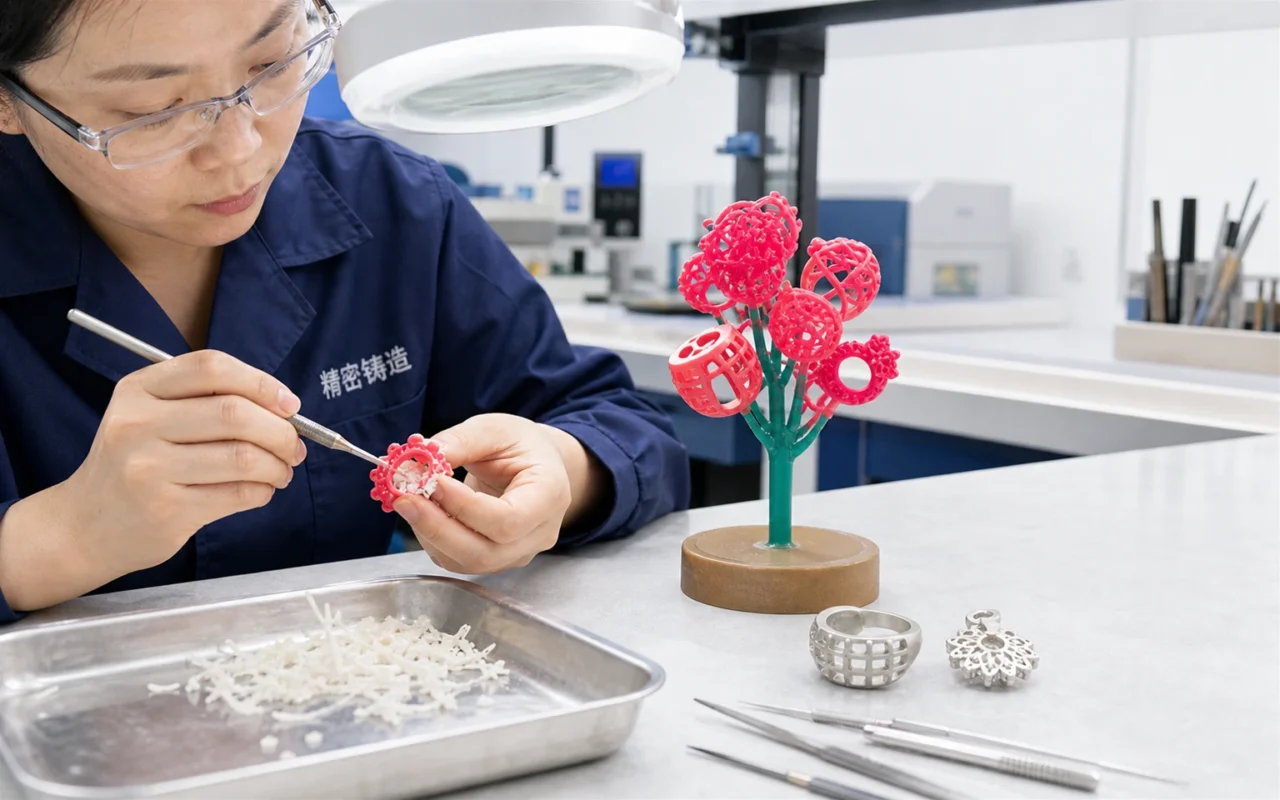
Jewelry lost-wax casting surrounds a disposable pattern with investment or a refractory shell, removes the wax and pours metal into the cavity. Patterns may be hand-carved or injection-molded; wax 3D printing creates them directly from jewelry CAD while a separate support wax holds complex features.
The method is well suited to one-off pieces, high-mix small batches, frequent revisions and products that do not justify a dedicated rubber mold. Its value is a shorter route from digital design to a castable pattern—not the removal of casting, finishing or setting.
Conventional model and mold preparation can take two to three weeks. Cprint 3D project data reports suitable direct wax patterns within one day. Compatibility with an existing investment, dewax and pouring line still has to be qualified with the actual wax and foundry schedule.
1. Prepare a castable jewelry model
A visually attractive render is not automatically castable. Check walls, prongs, holes, sharp transitions, joints and sprue access, and apply the foundry’s shrinkage allowance. Decide how stones will be set. Printed settings and cast-in-place stones are different processes; the latter requires a casting specialist to approve the stone, thermal cycle, investment and pouring risk.
2. Choose orientation and digital nesting
Orientation affects visible surfaces, support contacts, build time and cleaning. Avoid unnecessary force on filigree, thin prongs and openwork. Mixed designs can share a build, but need spacing, removal access and reliable identification. A full plate is not automatically the most productive plate; capacity is the number of accepted patterns ready for treeing.
3. Print and remove support wax
The printer deposits build and support wax layer by layer. After the job cools or conditions as required, remove support using the specified temperature, cleaning medium or combined process. Work gradually around thin prongs and deep channels to avoid heat distortion or breakage.
Follow the wax SDS for ventilation, personal protection and waste handling. Inspect for residue, contamination, distortion, cracks and critical dimensions. See the wax-pattern post-processing guide.
4. Tree and cast
Accepted patterns are joined to a central sprue. The layout must allow investment or slurry coverage, gas escape, metal filling and later cutting. The remaining steps include investing or shell building, dewaxing, firing, pouring, cooling, knockout, cutting, grinding, polishing and stone setting.
Printed wax can enter this established workflow, but chemical and physical compatibility must be confirmed. Review jewelry manufacturing and investment casting.
Best-fit applications
- One-off rings, commemorative pieces and private customization;
- designer collections, limited releases and market tests;
- filigree, openwork and engraved patterns that make tooling difficult;
- styles requiring frequent size, setting or proportion changes; and
- mixed designs in one production build.
When to compare another route
- Stable, high-volume basics may be cheaper with mature rubber-mold injection.
- A non-casting visual prototype may not require wax.
- Fully enclosed geometry may prevent support removal.
- Cast-in-place stones require separate material and thermal validation.
Use the wax versus castable-resin guide for a process comparison.
Evaluate speed, accuracy and cost with accepted parts
High-resolution wax printing can reproduce feathers, engraving, geometric openwork and other small details without a dedicated mold. Design changes require a revised file and a new build. Cprint 3D provides equipment, printing service and application support so a team can validate representative designs before purchasing a machine.
Review the 3H-420 or submit typical designs, daily volume and casting details.
Frequently asked questions
Can a printed wax pattern go directly into jewelry casting?
After support removal, inspection and process qualification, it can enter normal treeing, investing, dewaxing and pouring. Printing does not directly produce metal jewelry.
How does wax printing differ from castable resin?
Wax printing creates a wax pattern with removable support wax. Resin normally requires washing, mechanical support removal and post-curing. Burnout behavior and cost differ, so compare them with your own designs.
Can it produce filigree and micro-setting features?
Many fine features are printable, but orientation, support, wax and cleaning set the practical limit. A printable setting does not mean every stone can be cast in place.
Is wax printing suitable for both custom and batch work?
It suits one-offs and high-mix batches and can nest many designs. Compare long-running basic styles with rubber-mold injection on unit cost, cycle and yield.