
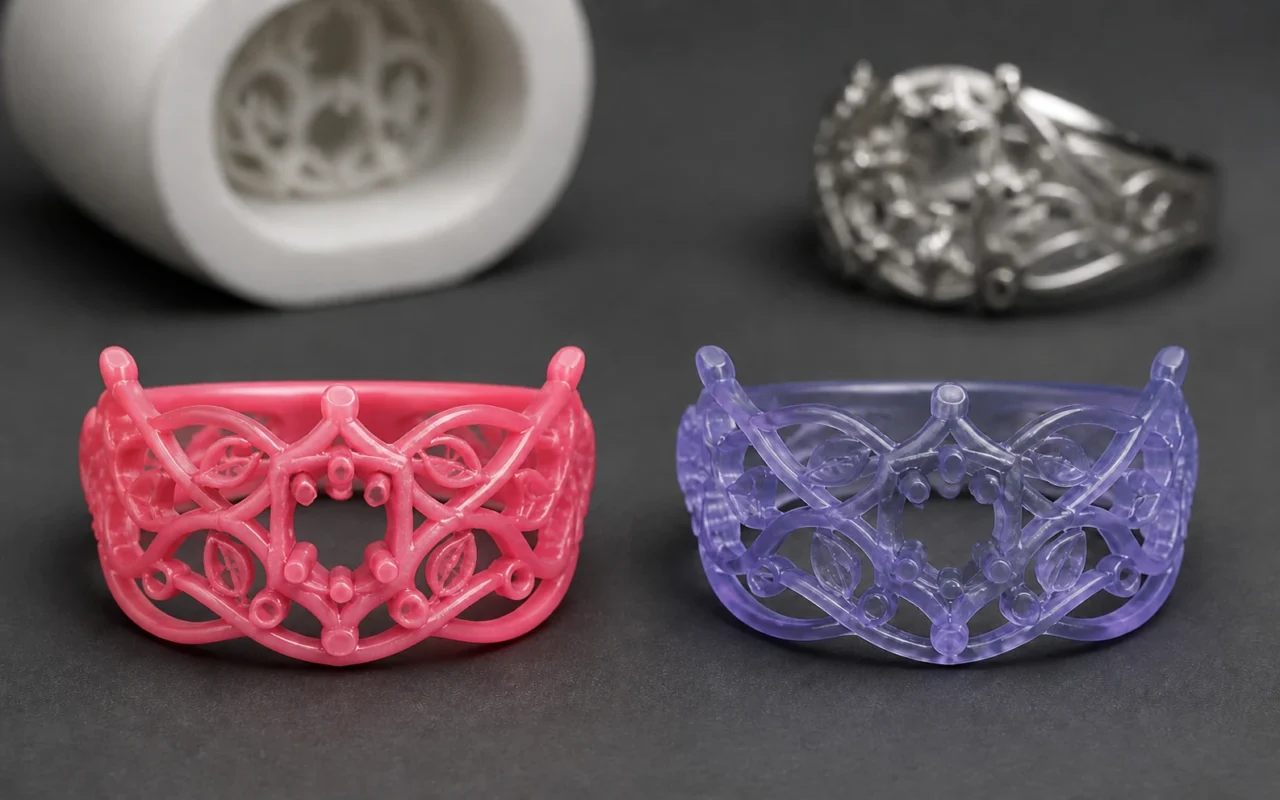
Wax jetting and castable-resin printing can both turn a digital jewelry or precision-casting design into a sacrificial pattern. The decision is not simply a contest of resolution. The two routes use different materials, build mechanisms and support strategies, and they create different requirements for cleaning, shell building, burnout and production planning.
The useful question is not “Which technology is more advanced?” It is which complete workflow better fits the part detail, production volume, delivery schedule, shell system and skills available in your operation.
How the two processes work
Castable resins are normally printed with SLA, DLP or LCD photopolymerization. A light source cures liquid resin layer by layer to create the pattern and supports from the same general material family. After printing, the part usually needs washing, support removal and secondary curing. For investment casting, it also needs a heating and hold program recommended for that specific material so the resin decomposes fully while expansion and residue are controlled.
Wax jetting uses industrial printheads to deposit build wax and support wax. Each deposited layer cools and solidifies before the next is added. Once the surrounding support wax has been removed, the build-wax pattern can move to inspection, tree assembly and shell building. Its main advantage is a wax pattern that fits naturally into a conventional lost-wax production environment.
For jewelry work, visit our jewelry manufacturing application page. For impellers, pumps, valves and other industrial parts, see investment casting applications.
Materials and support removal
Photopolymer patterns and supports are generally made from the same resin family. Contact points have to be clipped, sanded or finished mechanically, so support strategy directly affects fine prongs, openwork, thin walls and visible surfaces. In inaccessible cavities, the design also needs drainage, cleaning and burnout paths.
Wax jet systems typically use separate build and support waxes. The support wax surrounds or carries complex geometry and is removed with a temperature-controlled or solvent-based process matched to the material system. This reduces direct mechanical contact with fragile detail. It does not eliminate post-processing: temperature, dwell time, cleaning and waste-fluid handling still need a controlled procedure.
Do not compare surface and accuracy by specification alone
The finished result depends on the original CAD model, layer thickness, part orientation, support contact, material shrinkage, cleaning or dewaxing, shell building and metal shrinkage. Wax patterns are widely used where a consistent surface and fine texture are important. Resin printers can also reproduce fine geometry and are available in a broader range of machines and materials.
Run the same benchmark on both routes rather than comparing brochure resolution. Include:
- the finest lines, prongs and openwork;
- thin walls and holes in different orientations;
- large smooth curved surfaces;
- deep grooves and internal spaces that must be cleaned; and
- critical dimensions measured on the final casting.
A comparison that continues from CAD through the finished metal part is the only reliable way to determine which route fits your shell and pouring process.
Burnout and shell building determine casting results
Both wax and resin must leave the ceramic shell, but their thermal behavior differs. Conventional casting wax generally melts out first, with residue removed during later shell firing. Castable resin leaves mainly through thermal decomposition. Expansion, ash and recommended ramp profiles vary significantly between resin formulas, so use the material data sheet and a controlled trial to establish the process.
“Castable” does not mean drop-in compatibility with every wax process. When changing pattern material, check for shell cracking, ash, surface pitting, venting and metal fill, and document the furnace profile and tree layout. For repeat production, material-lot traceability and a standard operating procedure matter more than the appearance of one successful print.
For the downstream steps, read wax-pattern post-processing and the investment casting workflow.
Volume, labor and total cost
Resin printers cover a broad price and application range. They are flexible for design validation, studio work, customized low-volume pieces and general prototyping. Costs extend beyond resin to washing fluid, manual support removal, secondary curing, personal protective equipment and waste handling. A team already familiar with photopolymer workflows and processing a limited number of patterns per day may value that flexibility.
Wax jetting is more specialized around pattern production. For factories that continuously nest and print mixed jewelry or industrial wax patterns, it can reduce mechanical support removal and conversion steps while aligning with established treeing and shell-building practice. Its cost model includes build wax, support wax, machine maintenance, dewaxing stations and capacity utilization.
Material cost per part is therefore not total cost. Include operator time, failed reprints, machine occupancy, shell success and post-casting rework in the comparison.
For a production-oriented example, see wax 3D printing for rapid jewelry prototypes and small batches.
A practical selection guide
- For multipurpose prototypes, dental models or occasional castable parts, evaluate a resin route first.
- For sustained production of jewelry or industrial lost-wax patterns, give wax jetting a full production trial.
- For fine openwork, delicate prongs or geometry that is difficult to reach mechanically, compare cleanup damage on real benchmark parts.
- If your shell and dewax process is mature, verify how a new pattern material changes the existing furnace profile and shell behavior.
- For scale production, compare accepted metal output over a complete shift, not the speed of a single print.
The Cprint 3D 3H-420 wax 3D printing system is designed for jewelry and precision-casting pattern production. To compare routes using your own representative geometry, send us the files and production requirements for a review of printing, support removal and casting conditions.
Frequently asked questions
What is the main difference between wax jetting and castable resin?
The core differences are pattern material and post-processing. Wax jetting produces a wax pattern and generally uses removable support wax. Photopolymer printing produces a resin pattern that requires washing, support removal, post-curing and a burnout schedule validated for that resin.
Which type of support is easier to remove?
Wax support can usually be dissolved or melted away with a matched process, reducing mechanical contact with fine features. Resin supports are normally clipped and finished. Actual difficulty still depends on the geometry, orientation, material and work standard.
How do wax and resin patterns behave differently during burnout?
Wax normally melts out first; resin is removed mainly by thermal decomposition. Resin formulas vary widely in expansion and ash, so one unvalidated furnace profile should not be used for every material. Both routes require confirmation with supplier data and casting trials.
Should every jewelry producer choose wax jetting?
No. Wax jetting is well suited to recurring lost-wax pattern production, while resin may be more flexible for budget-sensitive, multipurpose or very small-scale work. Compare representative designs, daily volume and accepted casting yield.
What should we test before moving from resin to wax jetting?
Test fine prongs, thin walls, openwork, smooth surfaces and larger structures. Record the full sequence—printing, cleaning, treeing, shell building, dewaxing, casting and rework—instead of judging only the uncast pattern.