
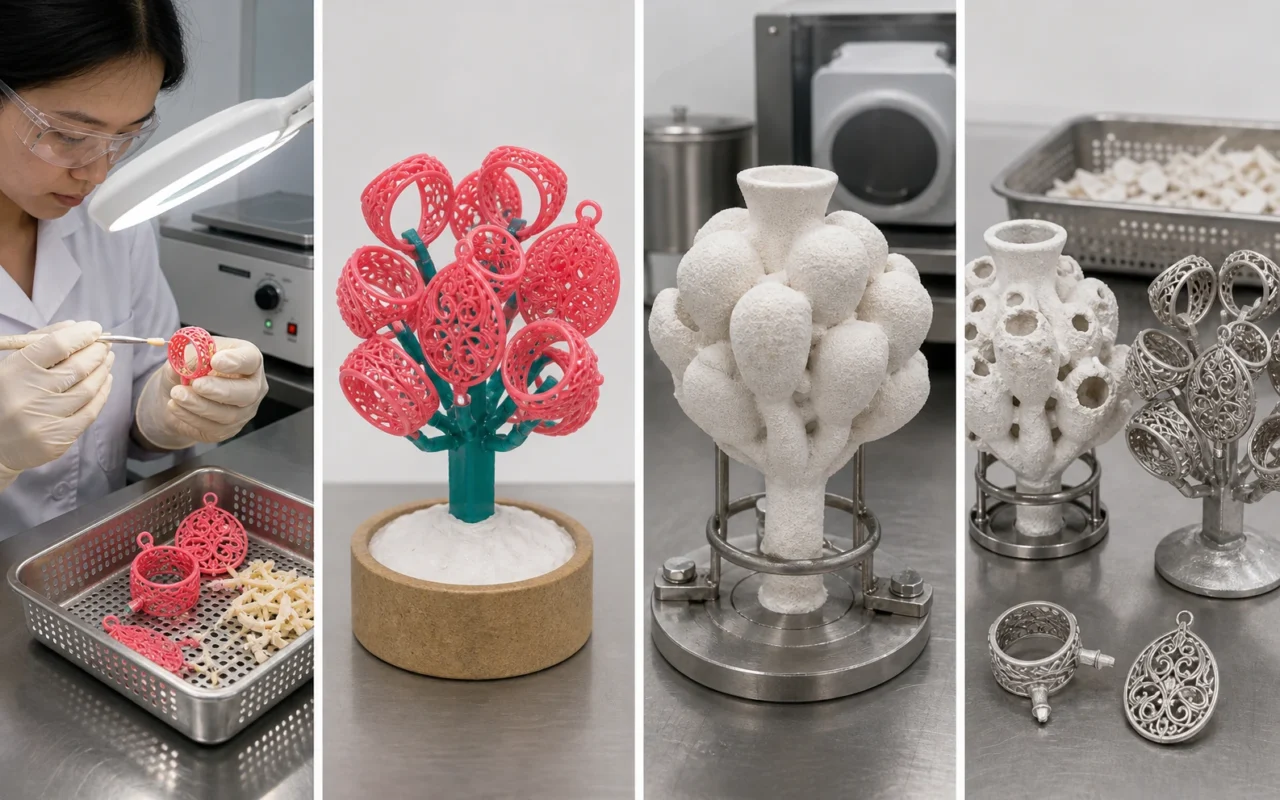
A wax jet printer does not produce a metal component. It produces a sacrificial casting pattern from 100% wax build material and support wax. Support removal, inspection, tree assembly, shell building, dewaxing, shell firing, pouring and finishing convert that pattern into jewelry or an industrial precision casting.
3D printing changes patternmaking; downstream operations remain part of a mature lost-wax system. Temperature, time, slurry, refractory and pouring settings must follow the actual wax, shell and foundry work instructions, not values copied from a general article.
1. Confirm the job before removing patterns
Check job ID, material lot and cooling or rest requirements. Do not bend or pry support from fine geometry. Use approved methods and personal protection to prevent burns, chemical exposure and detail damage.
2. Remove support wax
Use a temperature-controlled, dissolving or combined process matched to the build and support wax. Remove large external volumes first, then clean holes, grooves, openwork and thin prongs. Excess heat can distort the pattern; aggressive mechanics can break details. Remove residues and inspect deep features. Follow SDS, ventilation, fire and waste-fluid controls for every cleaning medium. Compare support strategies in wax jetting versus castable resin.
3. Inspect and finish the pattern
Check completeness, contamination, support residue, missing detail, distortion, cracks, critical dimensions and the treeing interface. Wax jetting can reduce hand finishing, but “no wax finishing” is not an unconditional claim: data, printing, cleaning and handling affect the result. Use approved measurement or scanning for dimension-sensitive industrial parts. Repair materials must be compatible with shell building and dewaxing.
4. Design and assemble the tree
Join patterns to a central sprue through ingates. Layout considers metal flow, feeding, venting, shell strength, dewax paths and later cutoff. Leave enough space for slurry and stucco to cover every surface. Smooth, strong wax joints should be free of sharp corners, gaps and debris. Jewelry and larger industrial patterns require different density and support. See jewelry wax printing and treeing.
5. Build the ceramic shell
Repeated dipping, stuccoing and drying forms the required thickness. The prime coat controls surface replication and needs careful wetting, bubble and contamination control; backup coats provide strength. Record ambient conditions, slurry viscosity, material lots and intercoat drying.
6. Dewax and fire the shell
After the shell meets requirements, remove wax according to the foundry procedure. Dewaxing balances evacuation speed and shell stress to avoid cracking. Firing removes residues and prepares the shell for pouring. A printed casting wax still needs a validated thermal program.
7. Pour, cool and finish
Preheat and pour according to alloy and process. After solidification and controlled cooling, remove the shell, cut gates, clean and heat-treat. Jewelry may continue through straightening, grinding, polishing and stone setting; industrial parts may need machining, dimensional and nondestructive inspection. See investment casting and jewelry manufacturing.
Maintain end-to-end traceability
Link CAD revision, print job, build and support wax lots, support-removal conditions, inspection, tree ID, shell lot, dewax cycle and melt. When surface, dimensional or shell-cracking issues appear, the team can investigate the complete process instead of adjusting only the printer.
The 3H-420 wax 3D printing system makes wax patterns directly. To validate them with your existing treeing and shell process, send the model and casting conditions.
Frequently asked questions
How is support wax removed?
Use a controlled thermal or dissolving process matched to both waxes, clean gradually and avoid mechanical damage. Follow the material data and work instruction for media, temperature and time.
Do printed wax patterns require hand polishing?
Not always. A qualified pattern may need only cleaning and inspection; visible surfaces, residue or local defects may need controlled finishing. Fix data and process issues before relying on polishing.
Can printed and injected wax patterns share a tree?
Usually, after validating material compatibility, joints, layout, dewaxing and shell behavior and keeping sources traceable.
Will printed wax leave the shell completely?
A qualified casting wax should meet process requirements under a validated dewax and firing program, but residue, shell cracks and surface results still require verification.
What should be inspected before shell building?
Completeness, cleanliness, residue, cracks, distortion, dimensions, repairs and tree joints, plus traceable file, material and job IDs.