
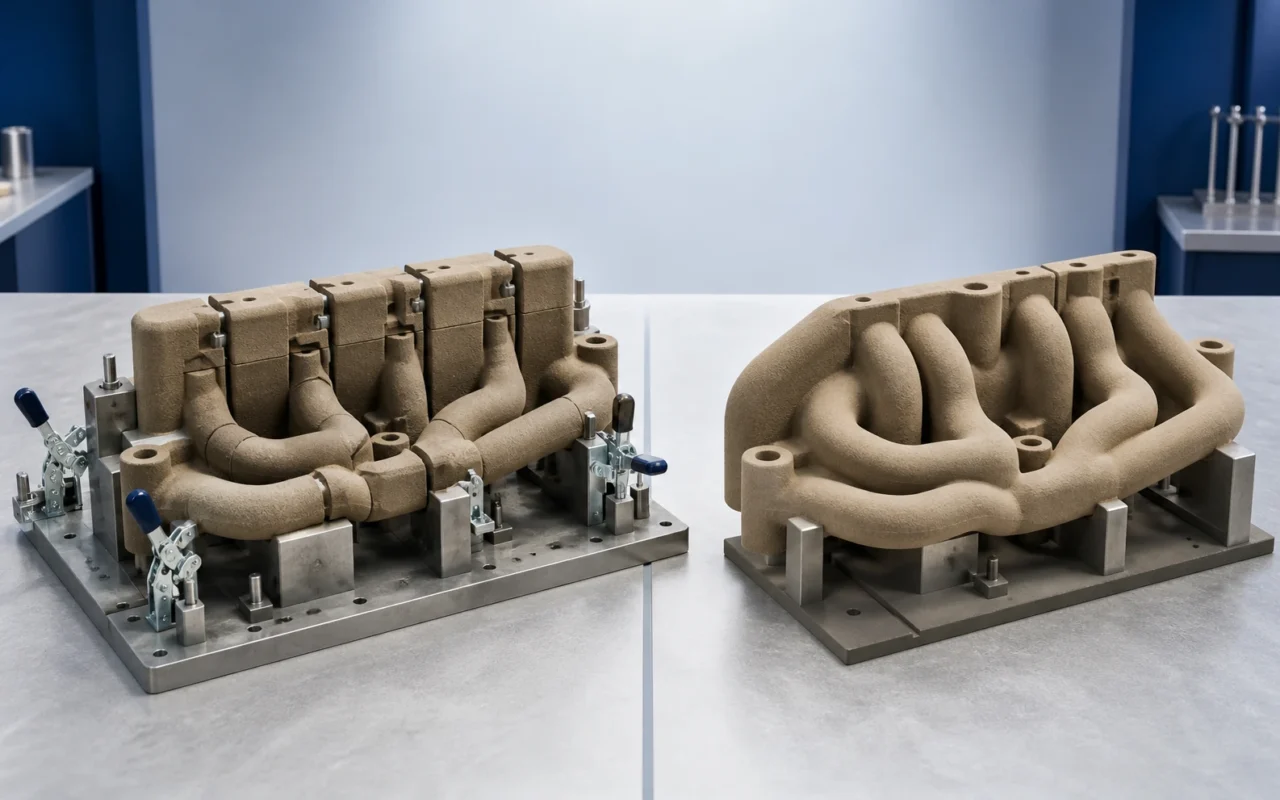
The internal geometry of a complex casting is often harder to manufacture than its exterior. A conventional sand core must leave a core box, so the design accounts for opening direction, draft, parting lines and access. A winding passage or intersecting cavity may be divided into several cores and assembled with core prints, adhesive and fixtures. Every additional core adds tooling, handling and location control and may introduce tolerance stack-up or fins at the joint.
Sand 3D printing forms the core directly from a digital file, without extracting it from a physical core box. Engineers can reconsider splits, eliminate selected core boxes and combine several conventional cores into fewer printed parts. Design freedom does not remove process rules: printing, depowdering, handling, pouring and shakeout still impose limits.
Why conventional cores are split
A core box must be machinable, fillable, curable and able to open. Undercuts, closed surfaces and intersecting passages often need a new split or loose piece. Large cores may also be divided because of weight and handling strength. Splitting is not inherently wrong; a mature core layout can improve stability and maintenance. It becomes a constraint when tooling investment, cycle time, assembly, adhesive joints and location error accumulate.
A hybrid approach is described in conventional molding with printed sand cores.
What core consolidation can improve
Without a conventional draw, parting lines and draft added solely for core-box manufacture may be reduced. Adjacent cores can be connected, and location, support, venting or error-proofing features can be designed into the digital model.
- fewer core boxes to design, machine, store and maintain;
- less manual assembly, gluing and fixturing;
- lower accumulated location error;
- fewer internal joints and mismatch steps;
- more continuous curved and organic passages; and
- faster preparation after a digital design update.
These are priority opportunities for digital mold and core applications.
New risks created by consolidation
A consolidated core may be heavier, more fragile or harder to clean. Every enclosed region needs an outlet for loose sand, and long narrow passages need a verifiable cleaning method. Slender cantilevers may need temporary support during handling; pouring requires review of buoyancy, distortion, gas and collapsibility.
- Can loose sand leave every internal region?
- Are thin sections strong enough for printing and handling?
- Can existing lifting and assembly equipment manage the weight?
- Is the vent path continuous, without gas traps?
- Can the core be removed from the casting after pouring?
- Do critical dimensions have measurable datums and an inspection plan?
The best solution is not always a single core. Reducing more than ten conventional cores to two or three manageable printed modules may create the lowest total risk.
Grede and Matthews examples
Grede Iron Mountain reportedly consolidated several conventional cores into one printed part, eliminated costly core boxes, reduced energy and assembly time and improved productivity by 40%. Workers moved from repetitive multi-core assembly toward higher-value machine, process and quality work.
Matthews International used printed sand to remove draft required for conventional pattern withdrawal and realize a detailed, complex anchor casting. The project received recognition in the 2024 AFS Casting Competition. The two examples illustrate the practical value of consolidation and of removing tooling-driven geometry.
For operating context, see the long-term sand-printer case study.
Foundry rules remain after draft is removed
A printed core does not need to be drawn from a core box, but metal flow and solidification do not change. Thin metal walls, sharp corners, isolated hot spots and poor flow paths can still cause cold shuts, shrinkage, distortion or cleaning problems. Use design freedom together with simulation, process experience and inspection capability.
No universal minimum passage or core thickness applies to every process. Grain size, layer thickness, binder, orientation, length, cleaning tools and pouring alloy all contribute. Validate representative samples instead of treating machine resolution as a castable-feature specification.
How to run a core-consolidation project
- Map current cores, core boxes, assembly steps and major defects.
- Identify features created by parting and draft rather than by casting function.
- Develop several consolidation concepts and compare cleaning, handling and venting.
- Print a representative section or first article and verify strength and dimensions.
- Run a casting trial and inspect passages, fins, inclusions, gas and cleaning.
- Freeze the data, parameters and inspection standard from the result.
The SJ-1200 sand 3D printing system can produce complex molds and cores. If multi-core assembly is a recurring problem, send the core data and current process for a consolidation review. Then read the complete binder jetting workflow.
Frequently asked questions
Can several conventional cores become one printed core?
Often the number can be reduced, but one piece is not always optimal. Cleaning, handling, venting, strength, mold assembly and shakeout must be reviewed together.
Does a 3D-printed sand core need draft?
Many tooling-driven draft angles can be removed because there is no draw from a physical box. Draft serving metal flow, machining or inspection may still be required.
How small can an internal passage be?
There is no process-independent answer. Grain, machine, passage length and direction, binder, cleaning and alloy all matter. Confirm the limit with representative trials.
How does consolidation affect dimensional accuracy?
Fewer joints can reduce stack-up and mismatch, but a larger core can distort during handling or pouring. Datums, support and inspection must evolve with the design.
Which design rules still apply?
Minimum wall thickness, cleaning outlets, vents, handling strength, core location, metal fill, hot spots, collapsibility and post-cast cleaning all remain. Printing removes core-box restrictions, not foundry physics.