
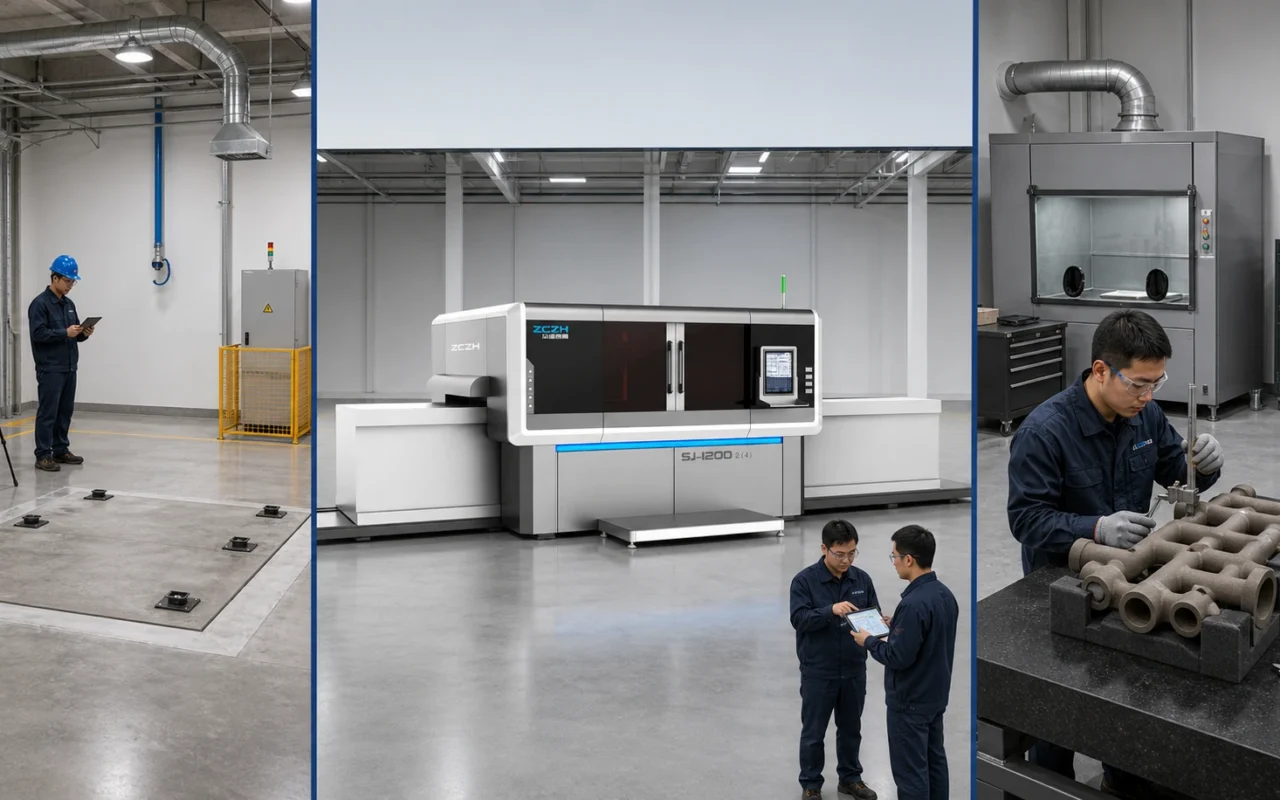
Once a foundry has analyzed its orders and decided to build in-house sand-printing capability, implementation begins before the machine arrives. Applications, facility, materials, people and quality systems need parallel preparation. Many projects struggle not because the printer cannot form sand, but because pilots are unrepresentative, finishing lacks capacity, supply is unstable or ROI includes only the purchase price.
Stage 1: Define business goals and the pilot mix
Set measurable goals such as shorter lead time for complex cores, fewer core boxes, spare-part support, new low-volume business or stronger file confidentiality. Include a simple baseline, a frequent complex core, a high-value tooling or assembly problem and a manageable development part. Follow every pilot through casting inspection. Begin with the readiness checklist.
Stage 2: Prepare the facility and utilities
Confirm power, compressed air, network, environment, floor loading and maintenance clearance. Put sand, binder, build-box movement, depowdering, curing, coating and inspection into the layout. Qualified specialists should address dust, chemicals, ventilation, collection, fire, spills and waste. Map incoming materials, build movement, fragile core handling and quarantine. See line planning.
Stage 3: Install, train and qualify materials
Document mechanical, electrical, software, safety-interlock and baseline-print acceptance. Train process, quality, maintenance and management as well as operators. Qualify sand and binder lots with strength, dimensions, surface, gas or other casting-relevant tests and confirm with a pour. Establish a separate processing and blend window for reclaimed sand.
Stage 4: Establish standard work and traceability
Before customer production, issue procedures for file review, nesting, startup, material issue, printing, removal, depowdering, curing, coating, inspection, storage and shipping. Each job should identify revision, lots, machine, time, operator and release result. Define stop, quarantine and reprint authority for printhead events, recoating defects, power loss, material interruption, damage and dimensional nonconformance.
Stage 5: Ramp capacity
Do not schedule full demand at nominal peak speed. Measure elapsed time from file preparation through release and find the bottleneck in printing, box change, cleaning, curing, coating or inspection. Increase shifts and nesting gradually while watching yield and maintenance. A printer waiting for depowdering does not justify another printer; jobs stopping on bad data require stronger review first.
Stage 6: Review ROI
Budget facility work, utilities, sand and dust systems, boxes and lifting, software, staff, training, spares, maintenance, inventory, inspection and first-article scrap as well as equipment. Review quarterly:
- orders routed to printing;
- tooling and design-change savings;
- order-to-approved-casting lead time;
- build utilization and uptime;
- first-pass yield for molds and castings;
- cleaning, finishing and maintenance labor; and
- new business, avoided downtime and protected delivery windows.
Industry implementation references
A dust system meeting ultra-low-emission requirements can itself cost several million RMB plus ongoing operation, so dust, energy and waste belong in ROI. Source examples cite a topology-optimized engine block with 15% less weight and improved heat transfer, a GE Aerospace turbine blade with 37 internal cooling passages in 2023, an 80% reduction in CAD-to-mold lead time, and SANY cutting development of a 200-ton excavator valve body from 45 days to nine.
KOCEL has reportedly built 12 satellite factories across six provinces with blockchain-based order, production and quality traceability, allowing digital files to become molds nearer the casting site. Other source references cite 92% less waste sand than conventional sand handling, a University of Bayreuth binder enabling 100% thermal reclamation and a 68% reduction in per-casting carbon emissions at BMW Leipzig. ExOne’s MicroMIM work was cited for ceramic/metal composite mold printing at 0.5 mm accuracy. A forecast that about 30% of global castings may use sand 3D printing or related digital casting by 2028 is directional, not a guarantee.
Use such figures as benchmarks, then calculate with your own orders, materials, shifts and yield. Review the application workflow, the SJ-1200, and submit capacity, facility and representative jobs. A real operating example is the Xixia case study.
Frequently asked questions
How long does implementation take?
There is no standard duration. Facility changes, qualification, training and customer approval all matter. Plan separate milestones for installation, first casting, process freeze and stable capacity.
Which costs are most often omitted?
Sand supply and dust collection, box handling, cleaning, curing, software, inspection, training, spares, inventory, first-article scrap and capacity lost to planned maintenance.
How is the first mold validated?
Start with approved data and material lots, inspect appearance, dimensions, strength and residual sand, then coat, assemble, pour and inspect the casting.
What maintenance supports continuous production?
Follow the machine manual for printheads, recoating, sand supply, filtration, motion, environment and safety systems, with critical spares and recovery procedures.
How should ROI be measured after launch?
Track tooling, lead time, printer and finishing utilization, yield, maintenance and new-business value together. Material cost or machine price alone is incomplete.