
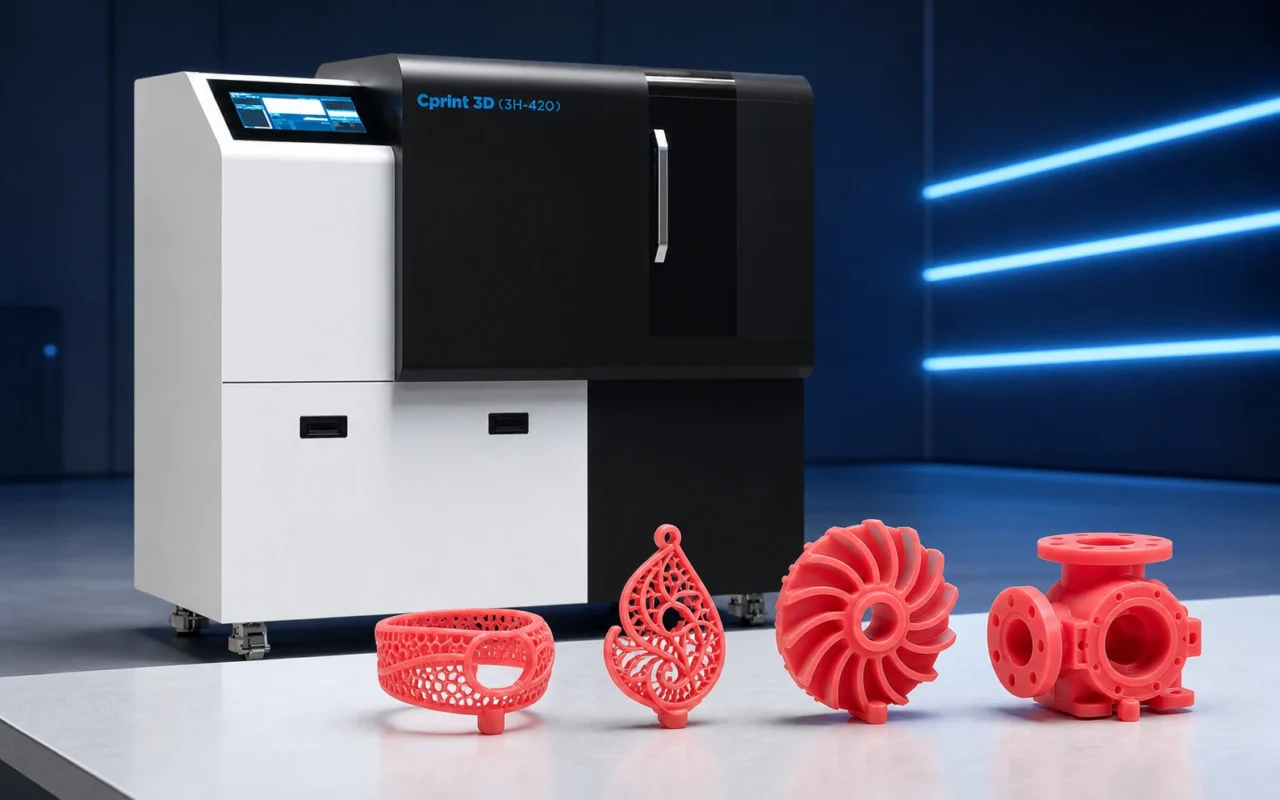
Version note: This article records 3H-420 capabilities announced in February 2026. Current configuration, materials and performance are governed by the latest product page, technical data sheet and project confirmation.
Cprint 3D’s update focused on multi-printhead production, industrial waxes, fine features and integration with lost-wax casting. The system creates wax patterns directly from 3D models; cleaned and inspected patterns then move into treeing, shell building, dewaxing and pouring.
Triple-printhead production
The 3H-420 uses three printheads to manage build wax, support wax and the related process. The practical value of this architecture is measured by complete build scheduling, continuous operation, printhead health and accepted patterns—not by one speed number.
Company test data from the release reported vertical build rates up to 6 mm per hour, approximately 24 hours for a full build and a 240-hour full-load test. Actual time and yield depend on geometry, nesting, layer strategy, material and maintenance condition.
Build area and batch nesting
The published maximum build area is 410 × 206 × 157 mm. Usable nesting must allow for orientation, supports, spacing, boundaries and cleaning access. Jewelry and small industrial patterns can share a digital build, but effective capacity should be calculated from accepted patterns after cleaning.
Use the current 3H-420 product page as the primary specification source. For production planning, see jewelry prototyping and small-batch production.
Waxes and fine-feature capability
The update also covered optimized build and support waxes. Under qualified conditions, the process was reported to reproduce 0.12 mm filigree features, with 4 μm surface accuracy and an N8-class finish. Removable support wax can reduce direct tool contact with delicate features, but support removal, cleaning and inspection remain necessary.
Suitable production tasks
- Custom jewelry, filigree, openwork and mixed-design builds;
- impellers, pumps, valves, art pieces and other complex industrial patterns;
- development and small batches without dedicated wax tooling;
- replacement projects with changing designs or unavailable tools; and
- factories connecting digital files to an existing investment-casting line.
Explore jewelry manufacturing and investment casting. The system was subsequently shown in the TCT Asia 2026 report.
Process boundaries remain
Wax printing does not remove cleaning, inspection, treeing, shell building, dewaxing, firing, pouring or casting inspection. Project material from the release reported total-cost reductions above 30% in suitable work, but a buyer should calculate results with its own labor, material, yield and volume. Request the current configuration or a model test.