
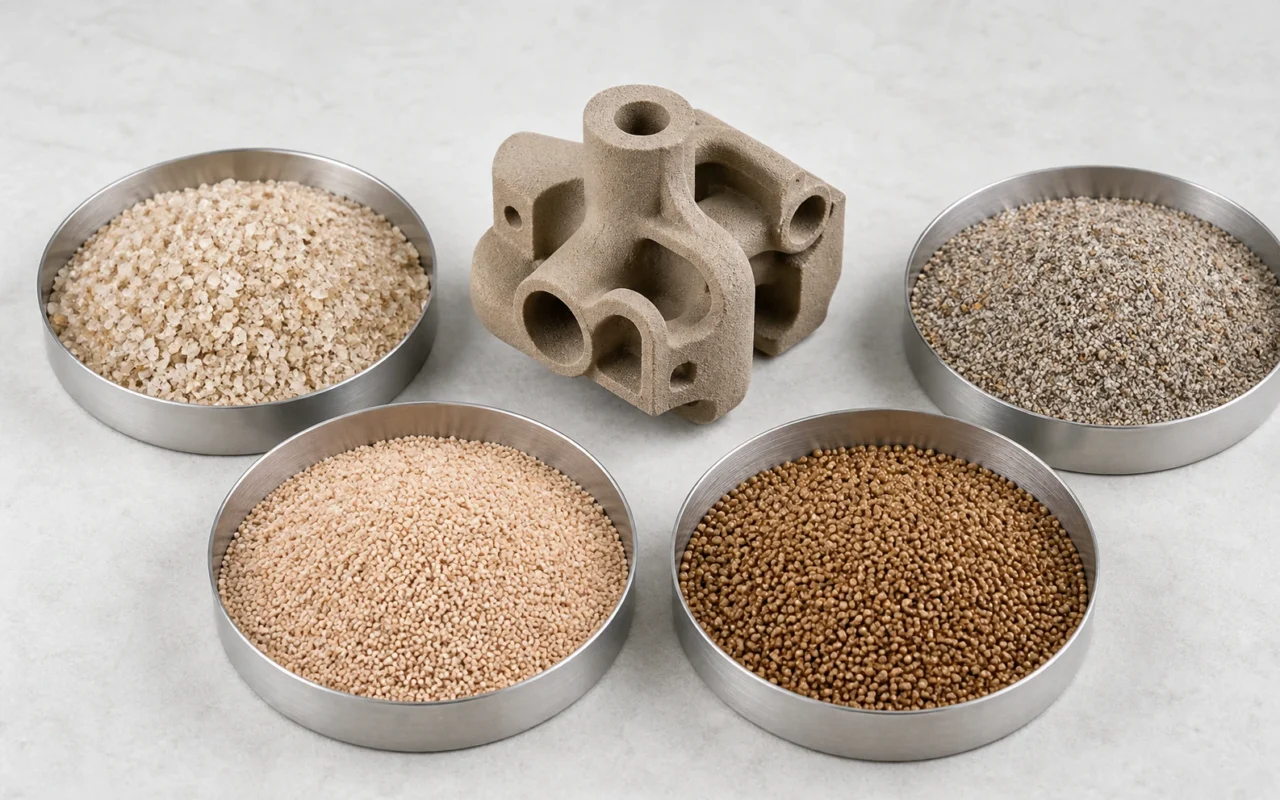
Industrial sand 3D printing is not a matter of adding binder to any available sand. The particles must work through supply, recoating, jetting, curing, handling and pouring. Even sand from one source can change with particle distribution, fines, moisture and reuse history.
Start with the target alloy and casting, then match machine and binder. Purchase price per ton is not the selection criterion.
Six core material indicators
Particle-size distribution
Printing sands commonly concentrate around 50–200 mesh, approximately 0.30–0.075 mm. Finer grains can improve detail but increase surface area, binder demand and permeability risk. Coarser grains may recoat and vent better but affect surface. Sea and desert sands often need classification to remove particles below 0.075 mm or above 0.3 mm. A validated, stable distribution matters more than one average.
Shape and flow
Rounded grains normally flow and spread more uniformly; angular grains interlock differently and have more surface area. Source data cites a typical angularity coefficient above 1.4 for desert sand and below 1.2 for spherical ceramic sand. Shape affects packing, binder demand and strength and must be tested with the recoater.
Refractoriness and thermal expansion
Higher pouring temperature normally requires greater refractoriness and stability. Silica sand is widely used and supported by mature practice, but its phase change and thermal expansion need management. Ceramic sands can perform differently at high temperature or on surface-sensitive work, with different cost and recovery.
Chemistry and binder compatibility
pH, surface condition, moisture and impurities affect binder reaction. Sea sand may contain 0.1–0.5% sodium chloride and require washing and firing. Desert sand may contain more than 90% silica yet have a surface film with poorer resin affinity. Professional foundry silica often exceeds 98% silica with clay below 0.5%. Requalify jetting, curing, strength, storage, gas and casting whenever sand or binder changes.
Permeability, gas and collapsibility
The mold needs handling and pouring strength, a gas path and post-cast removability. Maximum strength can mean more binder, more gas or harder shakeout. Target a process window that meets the part’s requirements.
Reclamation and lot control
Reused sand accumulates fines, binder residue and thermal history. Source data cites 50% greater surface roughness and 18% higher resin adsorption after five reuse cycles for spherical refractory sand. Screen, dedust, cool or reclaim, then blend with new sand by test result. Recovery above 90% is possible for qualified material, but accepted molds and castings—not weight alone—define usable recovery. See the binder jetting process.
Recoating, surface and high-temperature data
Clay-bonded sand with 15–25% clay may produce layer-density variation up to ±12% because of agglomeration; classified silica may hold variation within ±5%. Vibration-assisted recoating has reportedly increased packing density for poorly flowing desert sand from about 1.2 to 1.6 g/cm³.
Spherical refractory sand can have surface roughness below Ra 1 μm, reducing resin penetration by 40%. Blending with rougher sand above Ra 3 μm may rebalance penetration, strength and surface. Desert sand with combined potassium and sodium oxides above 2% may form a low-melting phase with binder near 1,400°C and increase deformation risk.
One development blend cited in the source is 60% 70-mesh silica, 30% 100-mesh ceramic sand and 10% reclaimed 50-mesh spherical refractory sand, reporting strength above 2.5 MPa and permeability above 120. Treat this as a trial reference, not a universal production formula.
Material comparison
| Sand | Potential advantage | Validate carefully | Typical consideration |
|---|---|---|---|
| Foundry silica | Widely available, mature cost and process knowledge | Expansion, fines, binder and alloy match | Many general molds and cores |
| Ceramic sand | Adjustable shape and high-temperature behavior | Cost, recoating, recovery and supply | Thermal, surface or alloy-specific work |
| Spherical refractory sand | Flow, refractoriness and low expansion potential | Binder demand, blending and recovery economics | High-temperature alloys and complex cores |
| Chromite and specialty sands | High refractoriness, chilling and penetration resistance | Density, conveying, cost and segregation | Local hot spots or selected steel castings |
| Processed natural sand | Potential local-resource benefit | Salt, clay, fines, grading, lots and compliance | Only after systematic qualification |
Commercial names such as ceramic or spherical refractory sand may refer to different chemistries and grades. Use the supplier’s exact TDS designation.
Can sea or desert sand be printed?
Untreated natural sand should not normally enter industrial printing. Sea sand may contain salt, shell, organics and unstable fines; desert sand may have unsuitable grading, shape or surface. Washing, classification, drying or surface treatment still require a cost, waste-compliance, lot-stability and casting review.
Source estimates place desalinated and classified sea sand near USD 80/ton versus about USD 50/ton for professional silica. Direct desert-sand material utilization may remain below 30%, while reclaimed professional foundry sand can exceed 90%. At present, qualified foundry sands are normally more economical once treatment, stability and recovery are included.
Recommended qualification sequence
- Define alloy, pouring temperature, surface and shakeout needs.
- Obtain sand and binder TDS/SDS and lot samples.
- Measure grading, fines, moisture, shape and critical chemistry.
- Verify feeding, recoating, jetting and removal on the machine.
- Test strength, dimensions, storage, permeability or gas as applicable.
- Pour a representative core and inspect the casting.
- Freeze supply, blending, reuse, inspection and change rules.
See sand molds and cores. Qualified materials for the SJ-1200 follow current technical documentation and trials. Contact the technical team for a material test and review qualification within the implementation roadmap.
Frequently asked questions
Which sands can binder jetting use?
Classified silica, ceramic, spherical refractory, chromite and other qualified foundry sands may be used when machine, binder and alloy match.
How do silica, ceramic and spherical sands differ?
Chemistry, shape, density, refractoriness, expansion, price and recovery differ. No material is best for every casting.
Can processed sea or desert sand be used?
Material development is possible after salt, clay, fines and unstable impurities are removed and grading, bonding, gas and casting are validated. Treatment and compliance must be economical.
How does grain size affect surface and permeability?
Fine grains usually improve replication but increase binder demand and may reduce permeability; coarse grains often do the reverse. A useful distribution balances printing and casting.
Can used printing sand be reclaimed?
Some can be screened, dedusted, cooled or reclaimed and reused at an approved ratio. Monitor fines, binder residue and lots and confirm with mold and casting results.