
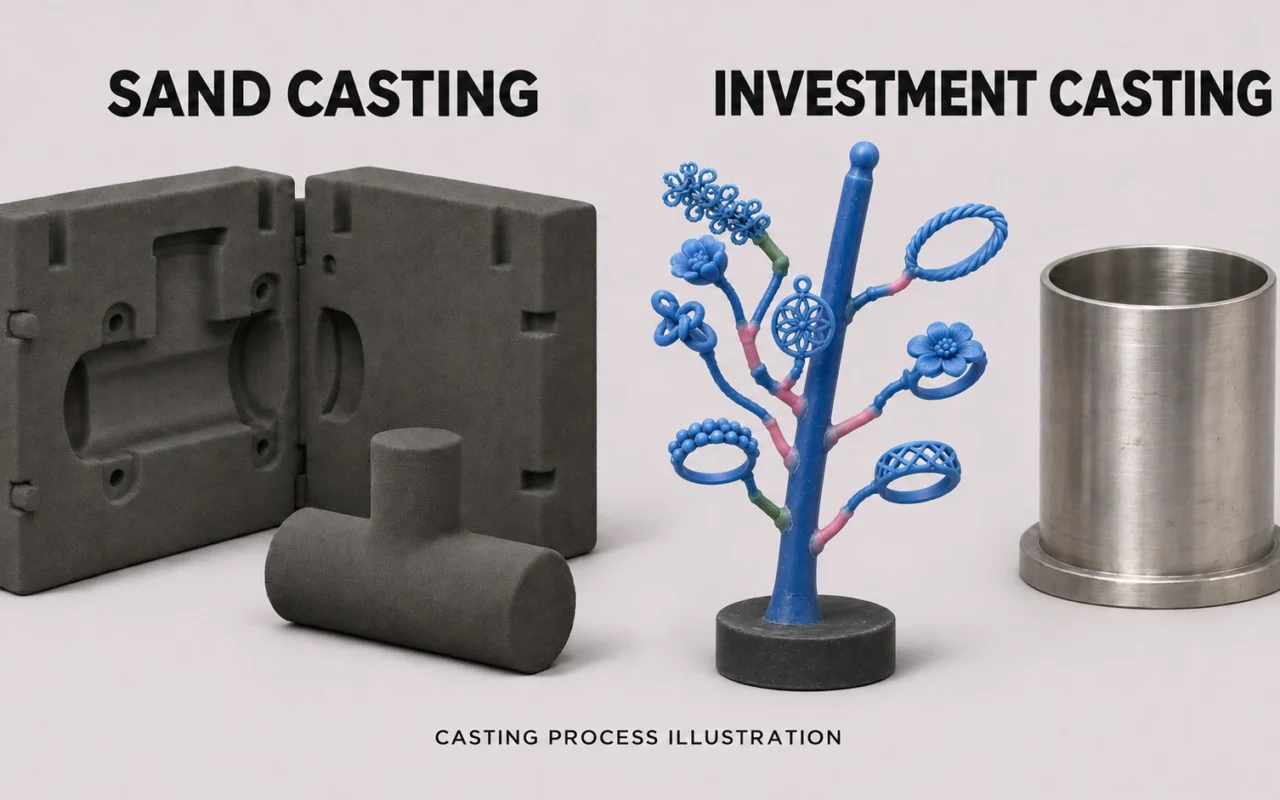
The main differences at a glance
The fundamental difference between sand casting and investment casting is how the cavity that receives molten metal is formed. Conventional sand casting builds a sand mold around a pattern and then removes the pattern. Investment casting surrounds a wax pattern or another expendable model with refractory material, then removes the model to leave a cavity.
This difference affects pattern removal, external detail, internal spaces, part size and subsequent machining. Both routes produce metal parts, but their strengths and the operations that need control differ.
| Aspect | Sand casting | Investment casting |
|---|---|---|
| Mold formation | Sand and a bonding system form the mold; cores are added when needed | A shell or solid investment surrounds an expendable model, which is then removed |
| Pattern reuse | Conventional patterns are usually reusable | Expendable wax or other models are usually made for each part |
| Common part characteristics | Broad size range; often housings, bases and cored parts | Often detailed parts with higher surface requirements |
| Internal cavities | Commonly formed by sand cores | Require suitable cores or a dedicated geometry solution |
| Surface and dimensions | Affected by sand, molding, mold closure and cleaning | Often supports detail reproduction; still affected by patterns, shells and alloys |
| 3D printing entry point | Sand molds and cores | Wax patterns or other suitable expendable models |
These are common process tendencies. Actual capability depends on the part dimensions, alloy, molding method and the foundry’s facilities and experience.
How the two processes form the mold cavity
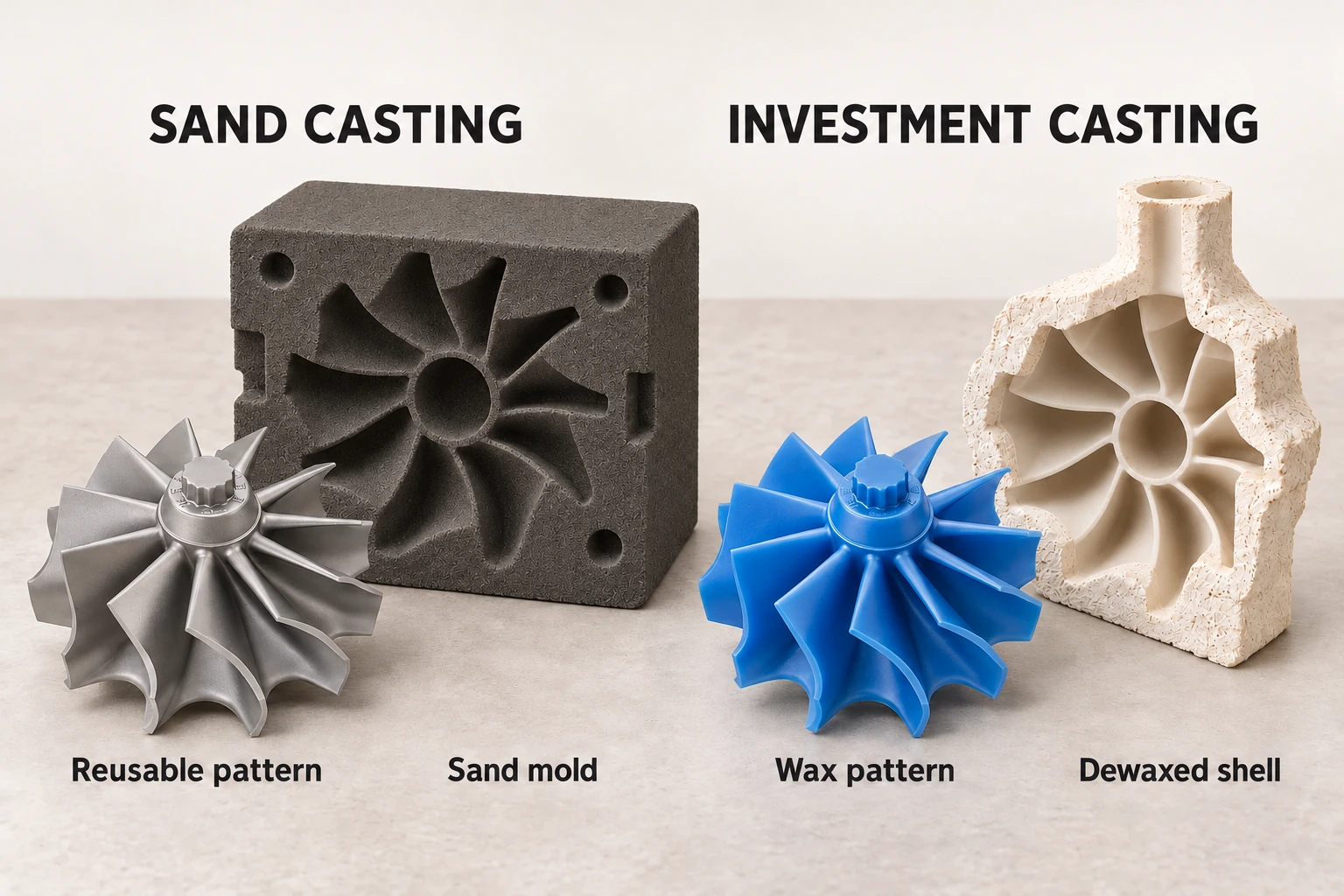
Start by distinguishing patterns, sand molds, sand cores and wax patterns. A pattern forms the mold contour; the sand mold receives molten metal and defines the outside of the casting. A core occupies the space that will become a hole or passage and is removed after the metal solidifies. A wax pattern reproduces the investment-cast part’s shape but is removed before pouring; it does not become the final metal part.
The American Foundry Society’s introduction to foundry sand also distinguishes molds that form external shapes from cores that form internal spaces. A bonding system holds the sand together through molding, handling and pouring.
A conventional sand-casting route can be summarized as: prepare the pattern and core box → make the mold and core and remove the pattern → set the core and close the mold → pour → cool and shake out → clean. Removing the pattern leaves a cavity; any required core remains in place until the metal solidifies.
An industrial investment-casting route commonly follows: make wax patterns → assemble a tree → build and dry successive shell layers → dewax and burn out → pour → remove the shell → cut off gates and clean. The wax is removed through dewaxing rather than withdrawn intact like a conventional sand-casting pattern, so the restrictions on pattern removal differ.
For a closer look at how shell building, dewaxing and pouring fit together, see Wax Pattern Post-Processing for Investment Casting.
The Investment Casting Institute’s shell-building explanation describes dipping a wax tree into slurry, applying stucco and drying, then repeating these steps to build a ceramic shell. Jewelry lost-wax casting also commonly uses solid investment: a wax tree is placed in a flask and investment material is poured around it. The Ransom & Randolph jewelry process describes this route. Solid investment and an industrial ceramic shell are different ways of preparing the casting mold.
Both types of casting mold generally need to be broken to release the part. An expendable mold is the sand or refractory mold that receives the metal; it does not mean that a sand-casting pattern can only be used once.
External detail and internal cavities are different challenges
A complex part may have detailed external curves, textures or undercuts, or it may contain curved passages, thin dividing walls or cavities that are difficult to clean. These create different casting problems.
Conventional sand casting must account for the direction in which the pattern is removed. Draft helps it leave the mold, while the parting line determines how the pattern and mold separate. Undercuts may require loose pieces, additional parting arrangements or cores. External geometry must therefore accommodate both the finished shape and practical pattern removal.
Investment-casting patterns are removed from within the mold, so the mold does not need to open along one common withdrawal direction. This often helps reproduce shapes that are difficult to draw, small lettering and decorative textures. However, pattern manufacturability, complete refractory coverage and the stability of fragile shell areas still affect feasibility.
Thin-wall casting also depends on metal flow, heat loss, gate position and local changes in thickness. Investment casting can support detailed geometry, but this does not mean every alloy can produce equally thin sections. A fine line in a model and a fine line fully retained on the casting must be assessed separately.
Internal cavities depend on cores. Sand cores can occupy pump and valve passages or engine cooling channels. Core positioning determines cavity location, while core strength and stability affect wall thickness and structure. 3D printing expands core-design possibilities, but venting and access for sand removal still need attention.

Investment casting can also form internal cavities using suitable ceramic cores or other dedicated core solutions. Removing the wax solves only part of the problem. If a refractory core remains inside, its positioning, support during pouring and final removal must still be addressed.
For example, a solid decorative part with lettering mainly presents an external-reproduction challenge. A housing with a simple outside but a curved internal passage may be harder to core and clean. Evaluate exterior geometry and internal cavities separately. SFSA’s steel-casting design guidance also stresses accessible openings for core removal, making this a part-design consideration.
Part size and weight
Sand casting covers a broad size range, from ordinary components to large housings, machine bases and heavy castings. With different sand systems, molding equipment and flask arrangements available, it is often a route worth evaluating first for large parts.
Size still has limits. Making the mold is only one consideration; melting capacity, pouring arrangements, handling and cleaning equipment also matter. Large dimensions and high weight are different measures: a large thin-walled housing and a smaller, heavy solid part may present very different challenges.
Investment casting is not limited to small parts. As a part grows, wax-pattern support, tree layout, shell building and drying, dewaxing and burnout, handling and pouring all require appropriate capability. A mature process for detailed small parts cannot simply be scaled up in proportion.
As an initial guide, evaluate sand casting for large parts and investment casting for detailed small or medium-sized parts. Confirm size limits and minimum wall thickness against the specific alloy, geometry and equipment.
How surface quality and dimensional accuracy affect machining
Investment casting is often used when a part needs retained detail, a good as-cast surface and less machining in some areas. The pattern surface contributes to the cavity surface, but the final casting also depends on the refractory face coat, pouring, solidification and cleaning.
Surface capability in sand casting varies widely. Sand grains, binders, mold coatings and pattern or printing quality can all influence the mold face. Mold closure and core positioning can affect dimensions and wall thickness. Two foundries using sand casting may still produce different results.
Compare surfaces in the same delivery condition. As-cast, blasted and polished surfaces are not interchangeable. For printed patterns, layer texture and post-processing may influence the replicated surface, so investment casting does not automatically make every area equally smooth. An ICI technical discussion of process conversion also distinguishes surfaces produced with conventional tooling from those produced through additive manufacturing.
Fine surface detail, dimensional stability and freedom from internal defects are separate requirements. An attractive housing may still need its bearing bore finish-machined; polishing a part with clear lettering may alter small edges. Requirements should apply to specific areas.
On the drawing, distinguish functional surfaces that require machining, ordinary surfaces that may remain as-cast and visible surfaces that need finishing. Relate tolerances, roughness and machining allowances to those areas instead of assigning one general precision label to the whole part.
How materials and quantity affect production preparation
Both processes can handle a range of metals. Alloy suitability also depends on melting practice, the sand or refractory system, wall thickness and foundry experience. Even for the same alloy, casting quality must be judged against service requirements.
The difference in preparation is easier to see. Conventional sand casting often uses patterns and core boxes to make molds and cores repeatedly. Conventional investment casting often uses wax-injection dies to make repeated wax patterns, then assembles each batch into trees and creates new casting molds.
Both routes may therefore use reusable tooling at the front end and continually produce expendable casting molds. Sand casting cannot simply be described as having tooling and investment casting as having none. They differ in the intermediate items that the tooling makes and the operations that follow.
As quantity grows, repeated molding or wax injection and the scheduling of core or shell batches affect production. Frequent revisions require identifying whether the exterior or interior changes, and whether only the relevant pattern, core box or print data needs updating. Investment casting can suit small quantities, while sand casting can also support repeated volume production.
Cost varies with tooling, consumables, labor, mold or shell preparation time and finishing requirements. The cheaper route must be assessed for the actual part and quantity, rather than inferred from the process name or one tooling charge.
Where 3D printing changes each process
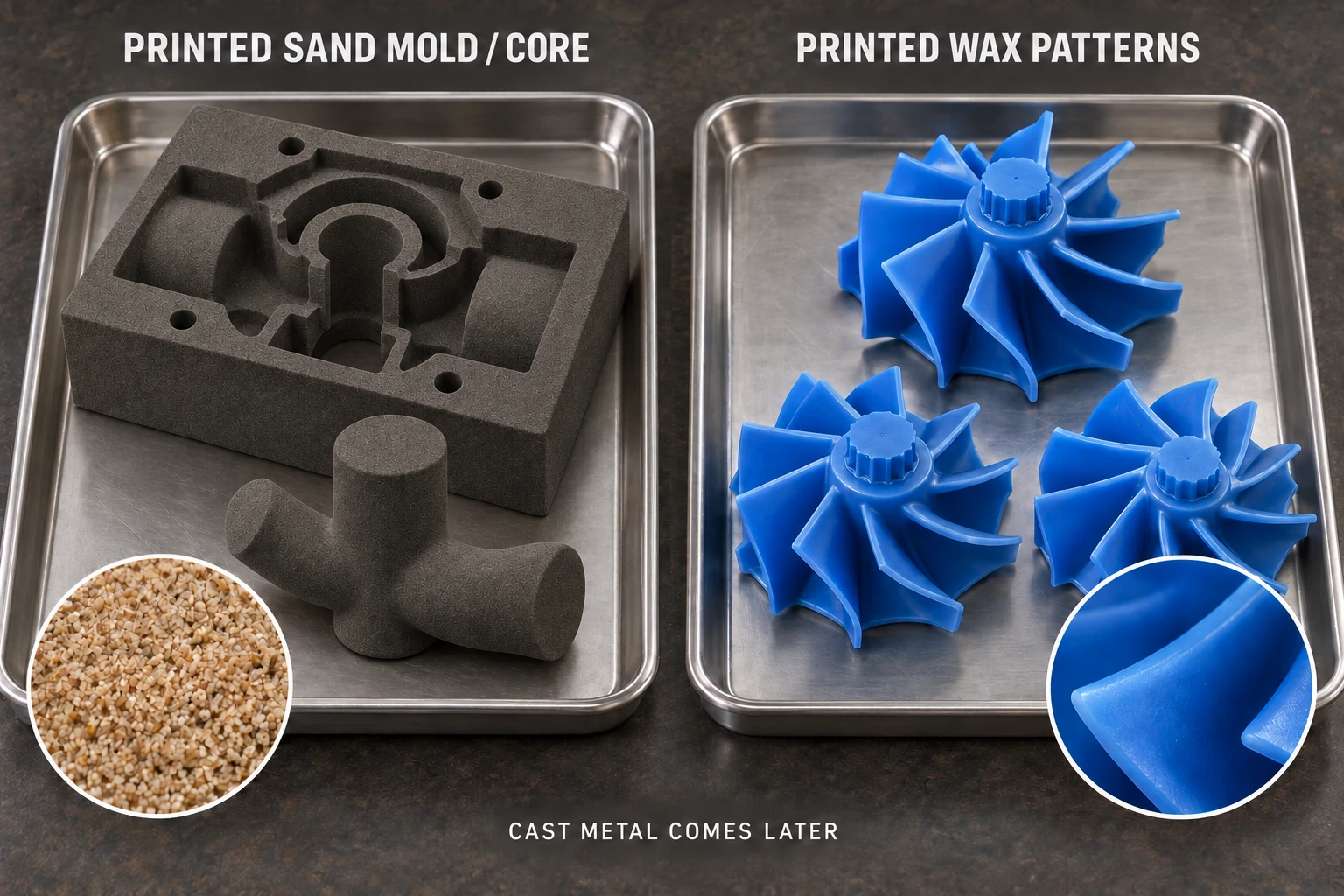
In the sand route, directly printing a mold reduces reliance on the corresponding physical pattern. Printing a core reduces reliance on the corresponding core box. If only the core is printed, the outer mold can still be made conventionally; the two methods can be combined.
Direct printing can also reduce some restrictions associated with pattern withdrawal or core-box release, bringing more complex geometry into consideration. Printed sand components must still withstand handling, assembly and pouring, and their internal passages must remain cleanable.
In investment casting, printing wax patterns or other suitable expendable models changes the front-end pattern-making step. Tree assembly, shell building or solid investment, model removal, burnout and pouring still follow according to the model and mold materials. Removal methods cannot be transferred unchanged between different model materials.
For example, Cprint 3D’s SJ-1200 produces sand molds and cores, while the 3H-420 Plus produces wax patterns for subsequent investment casting. The printers make casting intermediates; the final metal parts come from the casting operations that follow.
This distinction explains why printed sand components and printed wax patterns are not direct substitutes. They enter different mold-preparation workflows, and equipment selection must match the downstream casting process.
Which process should you evaluate first?
Start with the part’s most prominent manufacturing requirement to choose the first route to evaluate:
| Part requirement | Route to evaluate first | Key checks |
|---|---|---|
| Large housings, bases or heavy parts | Sand casting | Molding, melting, handling and pouring capacity |
| Complex internal passages | Sand molds and cores; investment-casting core solutions may also be assessed | Core manufacture, positioning, removal and inspection |
| Detailed exterior and demanding as-cast surfaces | Investment casting | Pattern quality, cavity replication and functional-surface requirements |
| Fine jewelry or decorative geometry | An appropriate lost-wax route | Materials and steps for solid investment or ceramic shells |
| Many variants or frequent revisions | Assess conventional tooling alongside digital manufacturing | Which intermediate changes and how the downstream process adapts |
This table is a starting point. Assess size, external geometry, cavities, alloy and critical surfaces together. One advantage can guide an initial choice, but it cannot replace an assessment of the complete part.
For a closer look at sand-casting operations, read the complete sand-casting process from molding to cleaning. To compare a wider range of routes, see the guide to selecting metal casting processes.
Frequently asked questions
Are lost-wax casting and investment casting the same?
Investment-casting processes that use wax patterns are commonly called lost-wax casting. Investment casting can also use other suitable expendable model materials; model removal and mold preparation must be confirmed for each system.
Are sand castings always rougher than investment castings?
Investment casting often favors detail and as-cast surface quality, but an absolute comparison does not apply to every part. Compare the same area’s requirements, actual samples and cleaning or finishing condition.
Can investment casting produce large parts?
It can be evaluated. The supplier needs suitable pattern-making, shell-building, burnout, handling and pouring capability. Local wall thickness and structural stability also affect feasibility.
Does 3D printing make the two processes the same?
No. Printing sand molds and cores and printing wax patterns change different front-end operations, after which the parts enter their respective sand- or investment-casting workflows.