
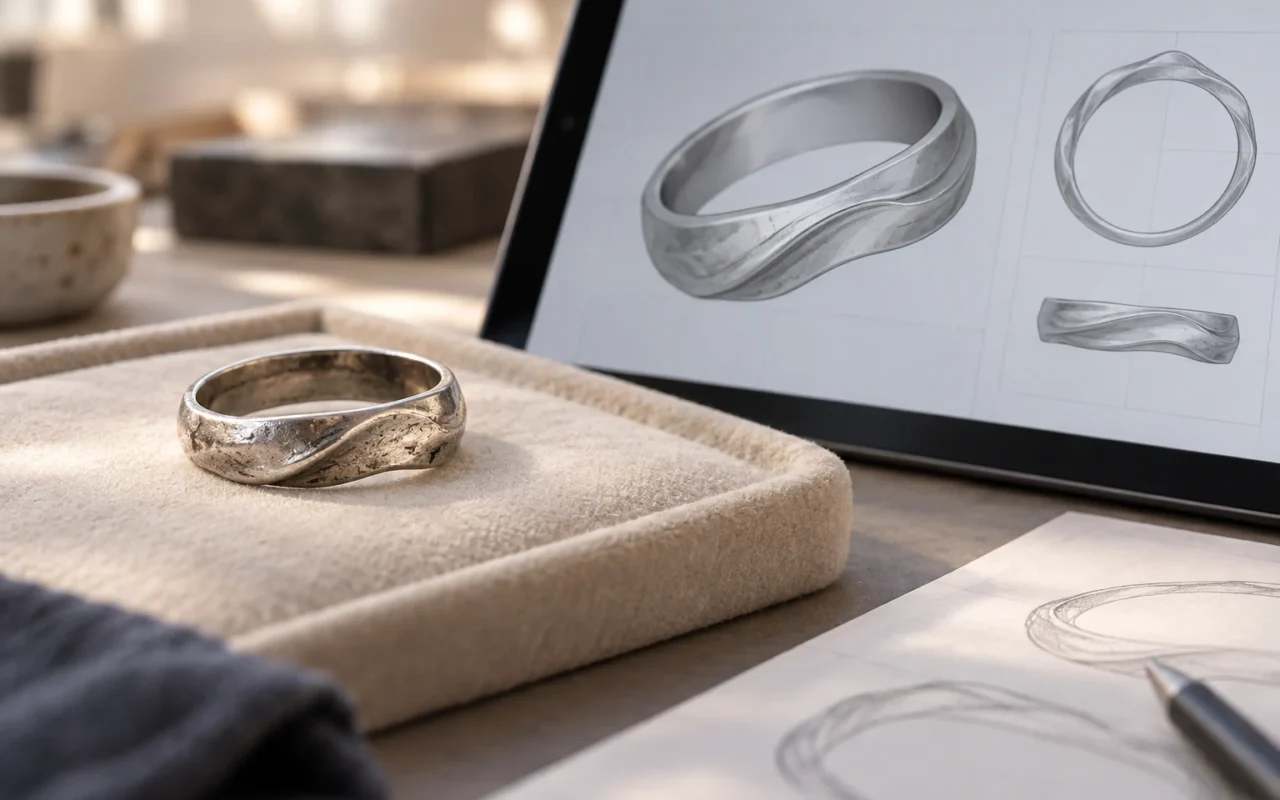
Older jewelry without a CAD file can still become a new production model through measurement, reference material and suitable digitization methods. First decide what is to be recreated: the object as it exists, an inferred original form, or a redesign that retains its style.
Those three aims produce different models. Wear, deformation, missing pieces and previous repairs may have changed the jewelry from its original design. Without an agreed objective, a detailed scan or reconstruction may faithfully copy features that were never meant to be retained.
Separate the Existing Condition from the Remake Objective
When receiving used parts, the appearance, dimensions, missing parts and known repairs should be recorded. Which details are from the actual object, which are from old photos, and which need to be redesigned should be marked separately.
For example, if a ring has obvious signs of wear and tear, the project may require that the traces of time be preserved, or the ring may want to restore its clear outline. This should be confirmed by the client and cannot be smoothed or re-engraved by default by the modeler.
Physical storage, applicable measurement and collection operations must also be agreed upon in advance. Methods requiring contact, fixation or surface treatment should be confirmed to not exceed the scope of authorization. For objects with gemstones, special surfaces or precious commemorative meanings, the operable conditions must be clearly stated first.
Also confirm permission to use graphics, brand marks and design materials. Digitization can help create documents, but it does not determine for the client whether other people’s designs and logos can be used for reproduction. Project records should retain authorized sources and permitted uses.
What Each Reference Can Tell You
The complete object can provide an observable three-dimensional surface and measurable dimensions, but the occluded areas still need to be judged. For missing parts or severely deformed objects, other references need to be added. Photographs can illustrate certain appearances, but they may not give reliable scale or hidden structure.
It is recommended to organize the data into three categories: “direct observation or measurement”, “reconstruction based on reference” and “still needs to be confirmed”. Key manufacturing information such as inlays, assembly connections, and ring circumferences should not be inferred solely from a photo without scale.
If you only have pictures, you can establish a style or form direction, but you should indicate which dimensions are being redefined by this round. Calling a visual resemblance a complete restoration obscures what the data itself cannot support.
Older models may also be made up of multiple parts. Hinged, buckled and inlaid structures require understanding of how to connect and use them. Merely copying the outer contours may not result in a manufacturable and assembleable structure.
Scanning and Production Modeling Are Different Tasks
3D scanning can help capture observable surfaces, but the quality of the capture is related to the object, equipment, posture and processing conditions. Reflective metals, transparent or light-scattering gemstones, and small patterns may make collection more difficult.
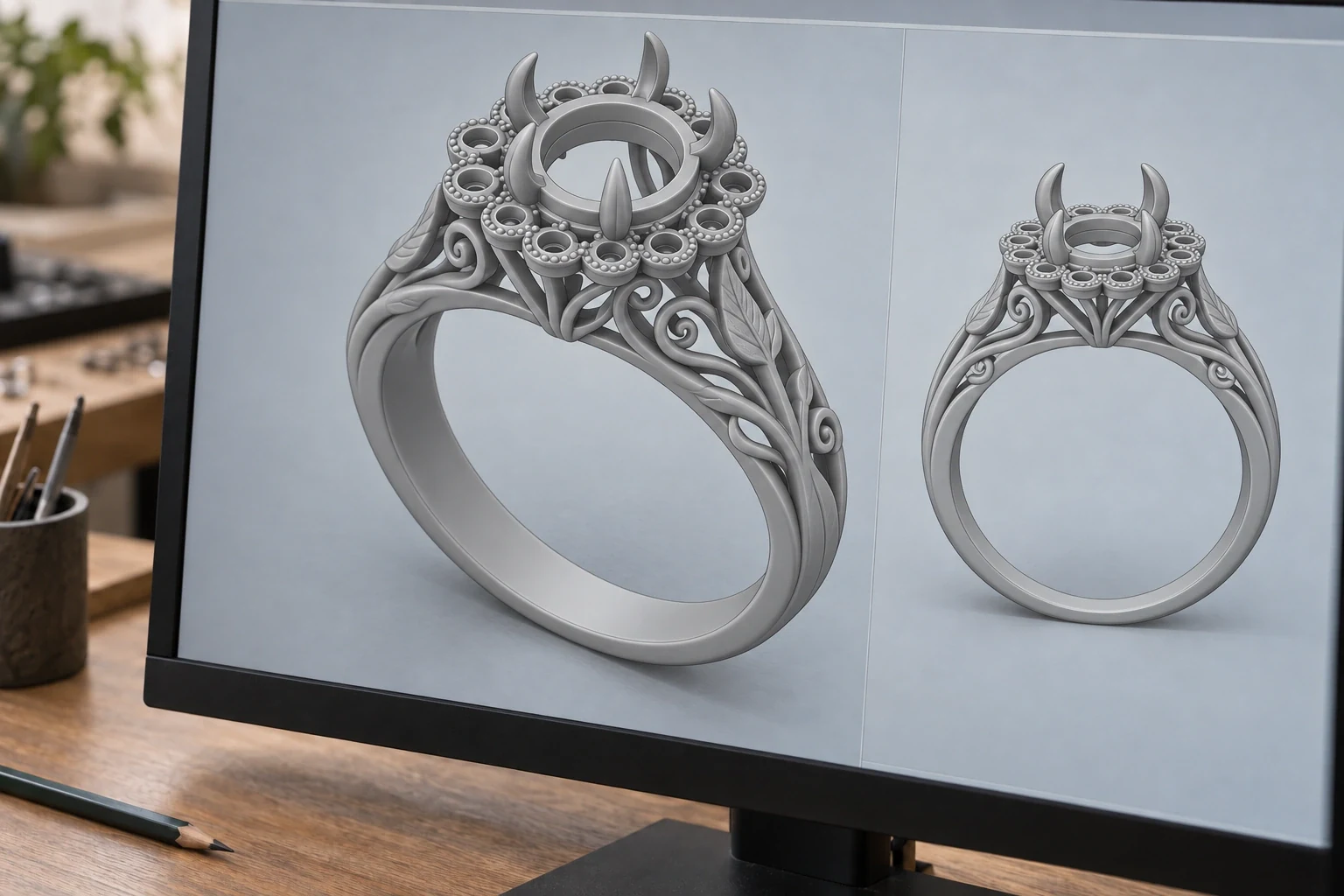
The Cooksongold jewelry digitization case released by Artec introduces the process of scanning and subsequent use of design software to modify the model. It shows that the collected data and subsequent model processing can be connected; the speed and equipment performance belong to this case and are not the unified results of all old projects. Jewelry digitalization case
The captured mesh does not automatically equal editable CAD with a clear design structure. Rhino’s STL specification distinguishes between mesh and surface representations. How subsequent modifications are needed determines whether to rebuild the model suitable for editing and manufacturing. Rhino mesh file description
The inner or blocked parts that are not collected need to be supplemented through measurement, reference or design confirmation. The software can fill in the gaps to obtain a continuous surface, but it cannot prove that the filled shape is the original structure.
Decide Which Handmade Features to Retain
Older jewelry may have slight asymmetries, handmade textures, and irregular corners. They may be style features, or they may come from wear or deformation, and should be included in the remaster target.
If the entire model is automatically symmetrized, the handmade quality may disappear; if the damaged parts are completely retained, a structure unsuitable for production may be continued. Comparison diagrams can be used to show the areas to be retained, restored and adjusted to allow the client to approve the specific plan.
Stones and connectors are also handled separately. It needs to be clarified whether the existing gemstones will continue to be used or whether they will be replaced with new matching stones. The wear state of the old setting may not be suitable for new gemstones, and the production model should be prepared based on the information confirmed in this round.
There’s more to approval here than just renderings. For the ring circumference, connection and setting, corresponding dimensions or feature drawings should be provided at the same time to ensure that the appearance direction is consistent with the manufacturing requirements.
Move from Digital Approval to a Wax Trial
Before outputting the print file, the version, units, components and key dimensions should be confirmed. After exporting the mesh, check the details for any unexpected changes. When repairing a file, keep a record of before and after processing.
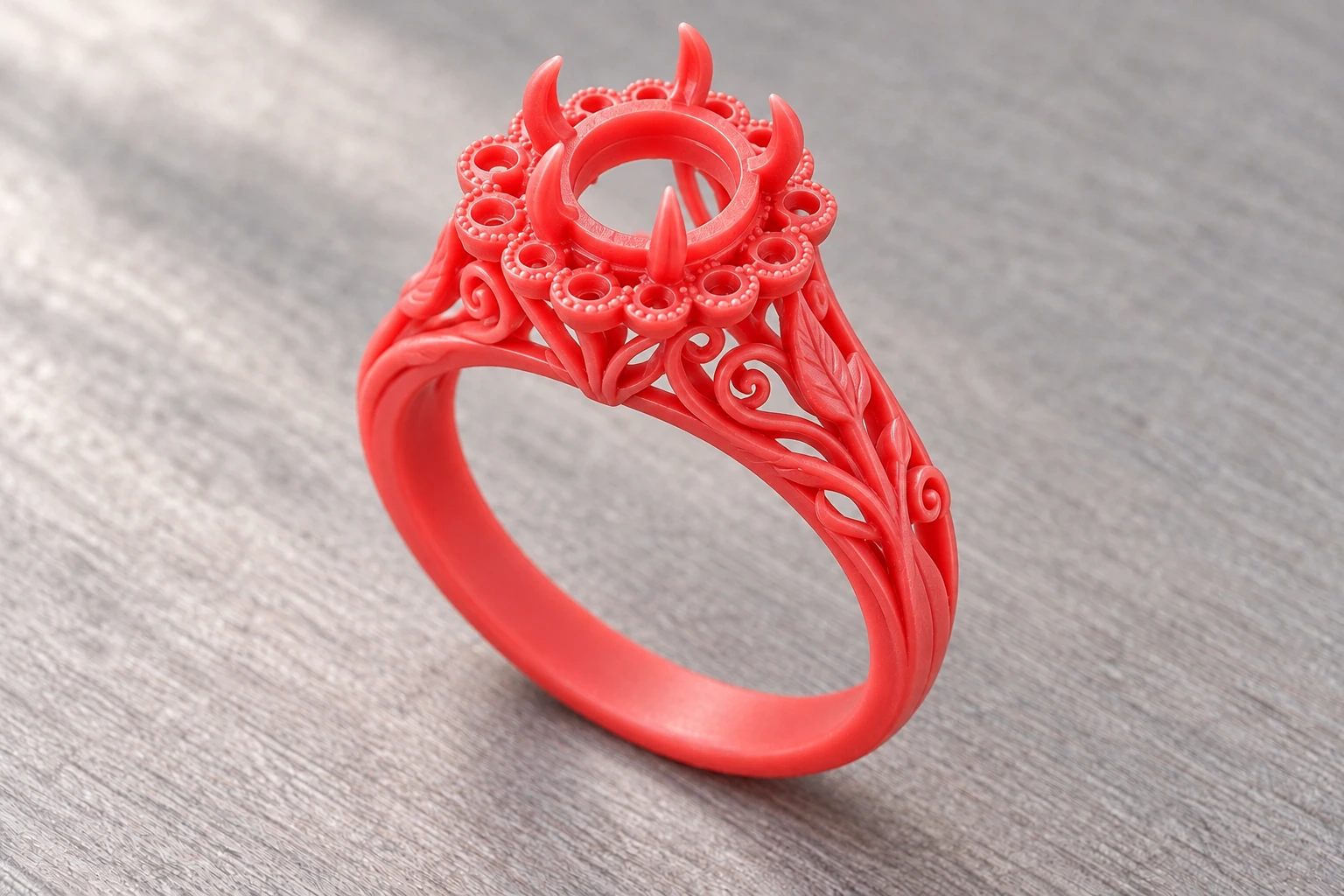
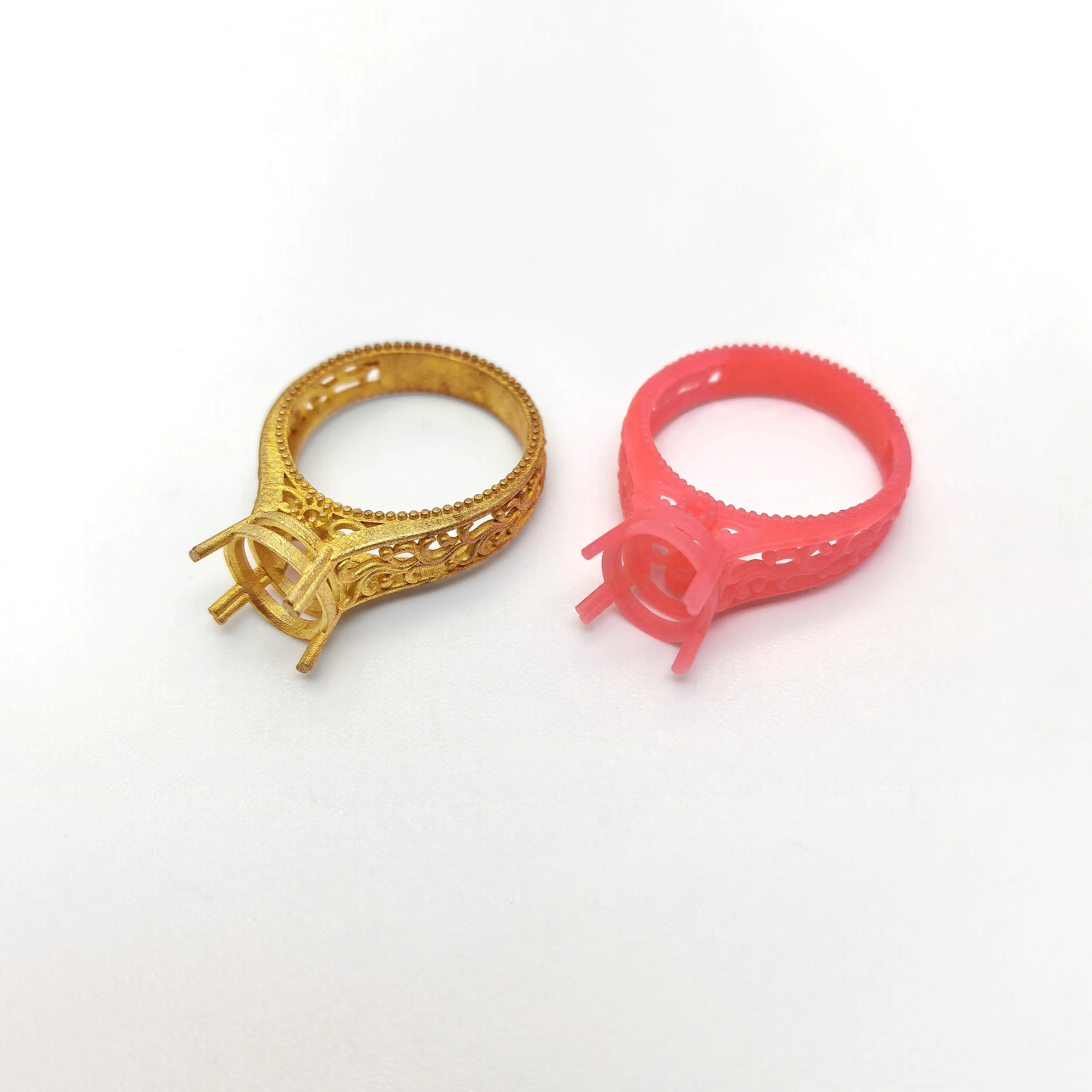
The wax model can be used to observe the volume, pattern and component relationship, and can also be used for casting trial production according to project requirements. The scope of inspection should be explained for different purposes. A pass on the appearance of the wax pattern does not mean a pass on the strength, durability or final setting of the metal.
GIA’s quality benchmarks discuss aspects such as ring circumference, surface finishing and setting respectively, suggesting that the final jewelry evaluation needs to be based on the specific production status. Here, acceptance should be formulated based on actual materials and project requirements, rather than just judging by numerical similarity. GIA Jewelry Quality Benchmarks
If the goal is to restore a certain finish, the final finishing step should be brought into the discussion. The visual effects of digital textures, wax-type details and metal processing may be different. If necessary, confirm by stage to avoid having to bear all the results for one rendering approval.
Approve the Reconstruction with a Difference Record
| area | Existing evidence | Processing this round | What needs to be confirmed |
|---|---|---|---|
| Outline and volume | Actual objects, scale photos or measurements | Keep or restore by reference | Target size and main viewing surface |
| wear pattern | Objects and old information | Retain, rebuild or redesign | Comparison pictures and style direction |
| missing parts | References and links | Rebuild or redesign | Function, structure and assembly |
| Ring girth and setting | Actual measurement and epicycle matching stones | Adjust according to approval requirements | Measurement methods and critical dimensions |
| Hidden area | Limited observations or supplementary measurements | To be confirmed or rebuilt according to plan | Presumption scope and verification method |
The difference table should avoid disguising presumed content as actual measurement results. Undetermined items that do not affect the purpose of this round can be retained until the next stage; items that are determined to be assembled or cast should be confirmed before entering the corresponding production.
Each review should clearly identify the approved version and purpose. The client approves the appearance reconstruction, but does not necessarily approve all process changes at the same time. Adjustments involving functional structure should be confirmed by the corresponding design and production personnel.
For the similarity of reproduction, the overall outline, key patterns and functional dimensions can be confirmed separately. When a certain texture is restored based on an old photo, and a certain inlay is redesigned based on the current round of stone matching, the differences should be marked on the same picture to avoid misunderstanding “similar to the old piece” as being a complete copy of every geometry.
Create a Reusable Digital Archive
Digital archives can include old part condition photos, measurement records, original acquisition data, editable models, approval grids, reconstruction differences and manufacturing results. This way, when remaking or revising again, you can go back to the clear source.
Original acquisition data and repair results should be saved separately. Otherwise, follow-up personnel may mistake the parts filled in by the software for the physical collection results. Areas of unknown or unidentifiable origin should also be noted in internal files.
Archives should also differentiate between historical objects and current round finished products. Even if the appearance is similar, the materials, workmanship and performance of the new parts still need to be confirmed according to the requirements of this round. Just because it’s from the same model, it doesn’t guarantee exactly the same performance as the old part.
Compare Two Remake Objectives Before Approval
Assuming that the older ring is more worn on one side, you can first show a record of the existing condition and then propose different options for retaining the wear or restoring the contours. Both options may be desirable, but the grounds for approval are different.
When choosing to preserve, make it clear which asymmetries and textures you want to leave behind; when choosing to restore, mark the reference basis and reconstruction areas. For details with insufficient data, the client can approve a new design, but it is not appropriate to claim that the original historical appearance has been restored.
Areas involving inlays and connections need to be confirmed with the production staff. Appearance approval is not a substitute for actual stonework and assembly requirements. The approved plan and dimensions are then filed together with the export file so that the wax pattern trial production can be mapped to clear goals.
If the metal sample needs to be readjusted, it should also be stated that this is a revision under subsequent conditions. Keep records of old parts and current changes to prevent new process changes from being mistaken for the original parts.
Reproduction confirmation should also indicate whether old parts will be returned, how the digital data will be delivered, and subsequent permitted uses. These are project handover conditions and should be recorded together with the model version to prevent new digital archives from losing their source and scope of use.
Frequently Asked Questions
Can Photographs Alone Produce an Identical Copy?
Photographs can be used to reconstruct directions, but dimensions, medial structure, and material details not shown need to be supplemented or redefined. The project should clarify what is data-supported recovery and what is current design.
Can Scan Data Be Printed Directly in Wax?
Dimensions, completeness, structural and manufacturing requirements need to be checked first, and the files need to be confirmed correctly by the actual software. The completion of collection and the release of production documents are two different conclusions.